鲍默《东方教会:亚述基督教图史》第三章:从多样到统一:教父与异端(中英文对照版)
阿甲按:本连载以克里斯托夫·鲍默(Christoph Baumer)2016年英文新版为底本,采用人工智能辅助中译,以中英文对照形式供研读参考。译文及原文提取仍有待校订,人名、地名、专业术语和个别断句未必准确,欢迎读者与专家指正。
本章导读
本章围绕三位一体与基督论争论,介绍安提阿及亚历山大的神学传统,梳理教父、教会会议与教义界定之间的关系,并讨论这些争论对东方教会身份的影响。
凡例
- 翻译自:Christoph Baumer, The Church of the East: An Illustrated History of Assyrian Christianity, new edition, translated by Miranda G. Henry (London and New York: I.B.Tauris, 2016),第三章,原书第 31–50 页。
- 本连载保留英文原文、图版与原书页码,采用双语对照形式,便于参阅和引用。原作页码与 PDF 文件的物理页序不同,本文标示原书页码。
- 中文初稿由 DeepSeek 辅助生成,部分缺译和遗漏段落使用 GPT-6-luna 补译;本次整理不等同于完成学术校订。原文中的个别断句、图注拼接和脚注提取仍需对照原书核查。
- 人名、地名、书名与叙利亚语专业术语的译法仅供参考,相关条目可参阅《高尔吉亚叙利亚遗产百科辞典》。
- 引用建议:克里斯托夫·鲍默,《东方教会:亚述基督教图史》第三章“从多样到统一:教父与异端”,袁永甲整理(人工智能辅助中译,待校订),教父原文中译计划,2026年10月12日,本文网址,并注明原书页码及访问日期。
第三章:从多样到统一:教父与异端
From Diversity to Unity:
从多样性到合一:
Church Fathers and Heretics III
教父与异端 III
The concept of the Trinity and the question of the nature of Christ
三位一体的概念与基督 (Christ) 的本性问题
‘For we know only in part, and we prophesy only in part.’
“因为我们所知道的有限,我们作先知讲道也有限。”
Metaphorically speaking, at the start of the second century the edifice of Christianity stood as little more than a great scaffolding, having neither a structured clergy, nor defined symbols, nor a generally accepted canon of the teachings of Jesus, nor a common understanding of God. Most of the construction remained to be done. Numerous architects, with varied visions and blueprints, contributed to the work. In contrast to Manichaeism, in which the religion’s founder himself recorded the fundamentals of his doctrine, and Islam, in which the text of the divine revelation was put in its definitive form about twenty years after the death of the prophet, the corresponding process in Christianity, in which the ‘discovery of the truth’ drew on the work of the Church Fathers, synods, councils and excommunications, lasted for nearly half a millennium. [^1] As a consequence of this slow development of Christian orthodoxy, many divergent doctrines emerged and were declared heresies. Without orthodoxy, no heresy could arise.
比喻而言,在二世纪初,基督教的大厦不过是一副巨大的脚手架,既没有建制化的神职人员,也没有明确的象征体系,既没有普遍公认的耶稣教导正典,也没有对上帝的共通理解。大部分建造工作仍待完成。众多建筑师带着各不相同的构想和蓝图,为这项工作添砖加瓦。与摩尼教 (Manichaeism) 和伊斯兰教 (Islam) 形成对比:在摩尼教中,该宗教的创始人亲自记录其教义的基本内容;在伊斯兰教中,神圣启示的文本在先知去世约二十年后被确定为其定本;而在基督教 (Christianity) 中,相应的进程——其中“真理的发现”借助了教父 (Church Fathers)、主教会议 (synods)、公会议 (councils) 和绝罚 (excommunications) 的运作——持续了近五百年。1 由于基督教正统教义发展缓慢,许多分歧教义纷纷出现,并被宣布为异端。没有正统,就不可能出现异端。
St Paul, First Letter to the Corinthians 13:9
圣保罗 (St Paul),《哥林多前书》(First Letter to the Corinthians) 13:9
The nucleus of fission within the Christian faith community lay in the concept of the Trinity, which signified a watering down of strict Hebrew monotheism.2 In light of the fundamental importance of the saving work of Christ and his central position in early Christian worship,
基督教信仰群体内部裂变的核心,在于三位一体 (Trinity) 这一概念,它意味着对严格的希伯来 (Hebrew) 一神论的淡化。2 鉴于基督 (Christ) 救赎之功的根本重要性,以及他在早期基督教崇拜中的中心地位,
Jesus is foremost man, not God
耶稣是首要的人,而非神
Christians could not fall back on the Hebrew transcendence of God but, rather, had to reconsider the relationship of Christ to the God of the Bible. Is there one God – or three? How were the relationships of the Father, Son and Holy Spirit to one another to be understood? Was there a hierarchy within the Trinity?
基督徒无法退回到希伯来式的上帝超越性上,而不得不重新思考基督与圣经中的上帝的关系。上帝是一位——还是三位?圣父、圣子与圣灵彼此之间的关系应如何理解?三位一体内部是否存在等级秩序?
In the struggle over the understanding of the Trinity, one group of theologians feared that a Trinitarian belief in Father, Son and Holy Spirit would necessarily lead to tritheism, the belief in three subjects, each with its own consciousness and will. Beginning in the second century, the Monarchianists, who were very concerned about monotheism, represented the doctrine of the sole sovereignty (monarchy) of the one God. They incorporated Christ in two different ways, both of which were deemed heretical because they denied the independence of the Son. Dynamic Monarchianism proceeded from the assumption that the man Jesus was first filled with divine power (Dynamis), in the form of a dove, at his baptism in the Jordan, at which point God adopted the man Jesus as Christ. Appealing to Jesus’s exclamation while on the cross, ‘My God, my God, why have you forsaken me?’,4 proponents of Adoptionism, such as Paul of Samosata (†272), taught that the human Jesus suffered and died on the cross, but the divinity of Christ did not. Since Theodore of Mopsuestia and Nestorius also taught that the human body of Christ, not God, died on the cross, both of these East Syrian Church Fathers were condemned as heretical Adoptionists – an accusation against which Nestorius resolutely defended himself.5 A view similar to dynamic Monarchianism was propounded by the ascetic Jewish-Christian sect called the Ebionites. For them, Jesus was the human son of Mary and Joseph and was made divine only by the pouring out of the Holy Spirit at his baptism in the Jordan. Modalistic Monarchianism, however, declared that both Christ and the Holy Spirit were modalities of God, which essentially eliminated the humanity of Jesus. This will be clarified in the next section.
在对三位一体 (Trinity) 理解上的争论中,有一群神学家担心,对圣父 (Father)、圣子 (Son) 和圣灵 (Holy Spirit) 的三位一体信仰必然会导致三神论 (tritheism),即相信三个各自拥有自己的意识和意志的主体。从二世纪开始,非常关注一神论 (monotheism) 的神格唯一论者 (Monarchianists) 主张唯一上帝的唯一主权(monarchy)教义。他们以两种不同方式将基督 (Christ) 纳入其体系,而这两种方式都被视为异端,因为它们否认圣子的独立性。动力神格唯一论 (Dynamic Monarchianism) 从这样一个前提出发:人耶稣 (Jesus) 在约旦河受洗时,首先以鸽子的形式被神圣力量(Dynamis)充满,在那一刻,上帝收养了人耶稣为基督。嗣子论 (Adoptionism) 的支持者,如萨莫萨塔的保罗 (Paul of Samosata, †272),援引耶稣在十字架上的呼喊“我的神,我的神,为什么离弃我?”4,教导说人性耶稣在十字架上受苦并死亡,但基督的神性却没有。由于摩普苏埃斯蒂亚的狄奥多雷 (Theodore of Mopsuestia) 和聂斯托利 (Nestorius) 也教导说,死在十字架上的是基督的人性身体,而非上帝,因此这两位东叙利亚教会教父 (East Syrian Church Fathers) 都被谴责为异端嗣子论者 (Adoptionists)——对于这一指控,聂斯托利坚决为自己辩护。5 一个与动力神格唯一论相似的观点,由称为伊便尼派 (Ebionites) 的禁欲主义犹太-基督教教派提出。对他们而言,耶稣是马利亚 (Mary) 和约瑟 (Joseph) 的人性儿子,只有在他于约旦河 (Jordan) 受洗时圣灵倾注下来,他才成为神圣的。然而,形态神格唯一论 (Modalistic Monarchianism) 宣称基督和圣灵都是上帝的形态,这实质上取消了耶稣的人性。这一点将在下一节中阐明。
These Trinitarian questions led, necessarily, to questions of Christology, the centrifugal force which broke Christian unity into three mutually antagonistic ecclesiastical organizations and pushed the Church of the East, in the view of the West, into the realm of heresy. At the heart of the matter lay the question of the nature of Christ: was he God or man or both? In the last case, how were the two natures connected? Did both suffer and die on the cross? Equally hotly disputed was the evaluation of the Jewish Bible, to whose prophecies Christianity appealed but whose Jewish interpretation it rejected. Was the spirit of the Jewish Bible at all compatible with the teachings of Jesus?
这些三一论问题必然导致基督论问题——这股离心力将基督教统一体撕裂为三个相互敌对的教会组织,并在西方看来,将东方教会 (Ch. of E.) 推入异端领域。问题的核心在于基督 (Christ) 的本性:他是神,是人,还是二者兼是?若是后者,两种本性如何结合?二者是否都在十字架上受难并死亡?对犹太圣经的评价同样引发了激烈争论:基督教诉诸其预言,却拒斥其犹太教解释。犹太圣经的精神与耶稣 (Jesus) 的教导究竟是否相容?
In the following section, we will discuss only those divergent doctrines relevant to understanding the East Syrian creeds. Since the questions of the Trinity and of the nature of Christ are so closely related to each other, we will consider them together until the moment of the Council of Constantinople. The doctrine of Theodore of Mopsuestia, the outstanding Church Father of the Church of the East, and Manichaeism will be handled separately. 3
在接下来的部分,我们将只讨论那些与理解东叙利亚信经有关的分歧教义。由于三位一体与基督本性的问题彼此如此密切相关,我们将把它们放在一起考察,直到君士坦丁堡公会议 (Council of Constantinople) 召开之时。东方教会 (Ch. of E.) 的杰出教父摩普苏埃斯蒂亚的狄奥多雷 (Theodore of Mopsuestia) 的学说,以及摩尼教 (Manichaeism),将另行处理。3
The path to the creed of Chalcedon shows the discovery of the permanent compromise between the two Christological extremes. One extreme overemphasizes the humanity of Christ and led towards the end of the fourth century to the Antiochene school of thought. The other extreme tends to exaggerate the divinity of Christ and neglect the human dimension, and it spawned the Alexandrian theology.
通往迦克墩信经 (Creed of Chalcedon) 的道路,显示出在基督论的两个极端之间发现持久折中之道的过程。一个极端过分强调基督的人性,并在四世纪末导向了安提阿学派 (Antiochene school of thought)。另一个极端则倾向于夸大基督的神性而忽视其人性层面,并催生了亚历山大里亚神学 (Alexandrian theology)。
Much more important than these trends was Arianism, which enjoyed great popularity in the
比这些趋势重要得多的是阿里乌主义 (Arianism),它在……广受欢迎
From Diversity to Unity: Church Fathers and Heretics | 33 fourth century and nearly destroyed the unity of the Church. The priest Arius (c.250–336), who was active in Alexandria, was a student of Lucian of Antioch (†312), one of the fathers of the historical biblical exegesis of the school of Antioch. The starting point of Arius’s doctrine was belief in the absolute transcendence of God and the Neo-Platonic principle that there must be a substantive and hierarchical distinction between a begetter, God the Father, and the begotten, Christ. God the Father and Christ are not alike in essence. Christ is not, in essence, God, but rather he is called divine only on account of his unconditional obedience to the Father and is subordinate to him. In a letter, Arius maintained: ‘The Son had a beginning, but God is without beginning.’6 Since there could not be two uncreated first principles – this would require the acknowledgement of two Gods – Christ was part of temporal creation, the most perfect creature. And so Arius reached his famous formula: ‘There was a time when he was not.’7 This statement diminishing the status of Christ had been anticipated by Bishop Dionysius of Alexandria (c.200–265) when he wrote, ‘Before he came to be, he was not.’8 Like Arius, Dionysius wanted to preserve both the transcendence of God and the independence of Christ. Like the later Theodore of Mopsuestia, Arius was convinced of the free will of Christ, which theoretically included the possibility of sin.9 However, since Arius taught neither the full divinity nor the full humanity of Christ – Christ appears as a sort of subordinate demigod – Nestorius strongly opposed him. restrictive concept of a ‘similar substance’ (homoiusios). The Gothic bishop Wulfila (311–382) adopted this position and said of the Trinity: ‘The Holy Spirit is neither God nor Lord, but rather the loyal servant of Christ, not equal to him but rather subject and obedient to him in all things; and the Son is likewise in all things subject and obedient to his God, the Father.’10 This formula was affirmed at the Councils of Rimini and Seleucia in 359/60, but again rejected at the Second Ecumenical Council of Constantinople. The orthodoxy of Nicea was taken up in the formulation of the three Cappadocian Fathers. They attributed an equality of substance to Christ and God the Father and defined God as one substance in three hypostases.11
从多样性到统一:教父与异端 | 33 四世纪,并且几乎摧毁了教会的统一。在亚历山大里亚 (Alexandria) 活动的长老阿里乌 (Arius,约250–336年),是安提阿的卢奇安 (Lucian of Antioch,卒于312年) 的学生,而卢奇安是安提阿学派 (school of Antioch) 历史性圣经解经的教父之一。阿里乌学说的出发点是相信神的绝对超越性,以及新柏拉图主义原则,即生者,即父神,与被生者,即基督之间,必须存在实质性的、等级性的区分。父神与基督在本质上并不相同。基督在本质上不是神,而仅仅因为他无条件顺服父,才被称为神性,并且从属于父。阿里乌在一封信中主张:“子有一个开端,而神没有开端。”6 由于不可能有两个非受造的第一本原——那将要求承认两个神——基督便属于时间性受造物,是最完美的受造物。于是阿里乌得出了他那著名的公式:“曾有一时,他并不存在。”7 这一贬低基督地位的表述,已由亚历山大里亚的主教狄奥尼修斯 (Dionysius of Alexandria,约200–265年) 预先提出,他写道:“在他存在之前,他并不存在。”8 与阿里乌一样,狄奥尼修斯既想维护神的超越性,也想维护基督的独立性。与后来的摩普苏埃斯蒂亚的狄奥多雷 (Theodore of Mopsuestia) 一样,阿里乌确信基督拥有自由意志,这在理论上包括犯罪的可能性。9 然而,由于阿里乌既没有教导基督的完全神性,也没有教导基督的完全人性——基督显得像某种从属的半神——聂斯托利 (Nestorius) 强烈反对他。限制性的“相似本质”(homoiusios) 概念。哥特主教乌尔菲拉 (Wulfila,311–382年) 采纳了这一立场,并论到三位一体说:“圣灵既不是神,也不是主,而是基督忠心的仆人,与基督不相等,反而在一切事上从属并顺服他;子也同样在一切事上从属并顺服他的神,即父。”10 这一公式在359/60年的里米尼会议 (Councils of Rimini) 和塞琉西亚会议 (Seleucia) 上得到确认,但在君士坦丁堡第二次大公会议 (Second Ecumenical Council of Constantinople) 上再次被拒绝。尼西亚 (Nicea) 的正统在三位卡帕多西亚教父 (Cappadocian Fathers) 的表述中得到继承。他们将本质的平等归于基督和父神,并将神定义为一个本质、三个位格。11
Despite this renewed condemnation of Arianism, it had adherents in the Eastern Roman Empire until the fifth century. It was for Nestorius, of all people, that this state of affairs had particularly bitter consequences. In his sermon on the occasion of his consecration as patriarch of Constantinople on 10 April 428, he threw down the gauntlet before the Arians by addressing Emperor Theodosius II with these words: ‘Emperor, give me your kingdom purified of the [Arian] heretics, and I will give you in return the Kingdom of Heaven.’12 The Arian partisans, thus provoked, preferred to burn down their own church rather than to hand it over to the new patriarch. The fire spread to neighbouring houses, and an entire quarter of Constantinople went up in flames, leading to great unrest. Nestorius’s inaugural sermon literally turned into an inflammatory oration. The situation was that much more explosive because all the Gothic soldiers stationed in Constantinople were Arian. Although the soldiers remained in their barracks, Nestorius had on his very first day in office incurred the anger of the Byzantine military leadership and a segment of the nobility.
尽管阿里乌主义 (Arianism) 再次遭到谴责,它在东罗马帝国仍拥有追随者,直到五世纪。而这一局面对聂斯托利 (Nestorius) 而言,偏偏产生了格外苦涩的后果。在428年4月10日就任君士坦丁堡 (Constantinople) 牧首的布道中,他向阿里乌派发起挑战,对狄奥多西二世 (Theodosius II) 皇帝说了这样一番话:“皇帝,请把一个清除了[阿里乌派]异端的帝国交给我,作为回报,我将把天国赐给您。”12 被如此激怒的阿里乌派支持者宁愿烧毁自己的教堂,也不愿把它交给新牧首。火势蔓延到邻近房屋,君士坦丁堡的整个城区陷入火海,引发了巨大的动荡。聂斯托利的就职布道字面意义上变成了一篇煽动性演说。局势之所以更加一触即发,是因为驻扎在君士坦丁堡的所有哥特士兵都是阿里乌派。尽管士兵们留在营房内,聂斯托利在上任第一天就得罪了拜占庭军事领导层和一部分贵族。
Although the First Ecumenical Council of Nicea condemned Arianism in 325, it spread throughout the empire, not least in the patriarchate of Antioch and among the Goths. While the council, under pressure from the emperor, defined the relationship of Christ to God the Father as ‘of the same substance’ (homousios), many bishops preferred the less
尽管第一次尼西亚大公会议 (First Ecumenical Council of Nicea) 于325年谴责了阿里乌主义 (Arianism),它仍在整个帝国境内传播,尤其是在安条克牧首区 (patriarchate of Antioch) 和哥特人 (Goths) 中间。虽然该会议在皇帝的压力下,将基督与父神的关系界定为“同一本质”(homousios),但许多主教更倾向于不那么
Jesus is foremost God, not man offices of priest and bishop were open to women.16 This rival Church remained active in the West until the end of the fourth century and east of the Euphrates until the seventh/eighth centuries, as one can see in the attacks of Nestorian theologians from this time.
耶稣首先是神,而不是人;司铎和主教的职位向妇女开放。16 这一与之对立的教会一直在西方保持活跃,直到四世纪末;在幼发拉底河以东则直到七/八世纪,正如人们从这一时期聂斯托利派神学家的攻击中所能看到的那样。
Like dynamic Monarchianism, modalistic Monarchianism was concerned about a strict monotheism. At the start of the second century Sabellius developed this position and taught that the one God acted in different ways (modalities): as Father he was Creator; as Son he was Redeemer; and as Holy Spirit he inspired humanity. This doctrine of Sabellianism, which Tertullian fought and Pope Callixtus (in office 217–222) condemned, led to Patripassianism, according to which the one God necessarily suffered and died on the cross – a heresy fiercely condemned by the theology of the Church of the East. A comparable view, closer to that of the Church of the East, is represented by Tertullian (160–225) when he wrote about the divine and the human in Jesus: ‘We see a doubled nature, not mixed, but connected in one person, God and the human being Jesus.’ According to this formulation, the suffering on the cross affected only the human nature of Jesus, not the divine, since ‘God cannot suffer’.13
与动力神格唯一论 (dynamic Monarchianism) 一样,形态论神格唯一论 (modalistic Monarchianism) 也关注严格的一神论。二世纪初,撒伯里乌 (Sabellius) 发展了这一立场,并教导说,独一上帝以不同方式(形态)行动:作为父,他是创造者;作为子,他是救赎者;作为圣灵,他启发人类。这一撒伯里乌主义 (Sabellianism) 学说——德尔图良 (Tertullian) 曾与之斗争,教宗加里斯都 (Callixtus)(在位 217–222 年)予以谴责——导致了圣父受难论 (Patripassianism)。按照该说,独一上帝必然在十字架上受难并死亡——这是东方教会 (Ch. of E.) 神学激烈谴责的异端。一种与东方教会 (Ch. of E.) 观点更为接近的类似看法,体现在德尔图良 (Tertullian)(160–225 年)论到耶稣里的神性与人性时所写的话中:“我们看到一种双重本性,并非混合,而是在一个位格中相连,即上帝与人耶稣。”按照这一表述,十字架上的受难只影响耶稣的人性,而不影响其神性,因为“上帝不能受难”。13
Marcionism resolved the dilemma of evil in the world by means of a divine dualism and considered the Good News of Jesus a radical re-evaluation of all Jewish values. The Christian God of love could never be identified with the angry and punitive God of the law. The God of the Jews created the evil world and ruled it with his unmerciful law. The Good News, by contrast, teaches the distant God of love and mercy, who revealed himself in Jesus Christ. Jesus put on a subtle, apparent body and allowed himself to be put on the cross by the evil demiurge, thus redeeming humanity from the grasp of this demiurge. Since Marcion read the Jewish Bible from a strict historical perspective and rejected allegorical exegesis, he reached the conclusion that it was comprehensible only in a Jewish context and thus meaningless for a Christian. Since Jesus prevailed over Mosaic Law, the Jewish scriptures have become irrelevant. Thus Marcion dismissed the Jewish Bible as the Old Testament and replaced it with his New Testament. This included the Gospel of Luke, as well as ten Pauline letters, which he purified of supposed Jewish adulterations. Acting out of his funda- mental Docetism, he also expunged references to Jesus’s youth, baptism and resurrection.
马吉安主义 (Marcionism) 通过神性二元论 (divine dualism) 解决了世间恶的难题,并将耶稣 (Jesus) 的福音 (Good News) 视为对一切犹太价值观的彻底重估。基督教的慈爱上帝绝不可能与律法那愤怒而惩罚性的上帝相等同。犹太人的上帝创造了邪恶世界,并以他无情的律法统治它。相比之下,福音教导的是那位遥远而慈爱怜悯的上帝,他在耶稣基督 (Jesus Christ) 里启示了自己。耶稣取了一个精微而表面性的身体,并任由自己被邪恶的德穆革 (demiurge) 钉上十字架,从而将人类从这位德穆革的掌控中救赎出来。由于马吉安 (Marcion) 以严格的历史视角阅读犹太圣经 (Jewish Bible),并拒绝寓意解经,他得出结论:它只有在犹太语境中才能被理解,因此对基督徒毫无意义。由于耶稣胜过了摩西律法 (Mosaic Law),犹太经文已变得无关紧要。因此,马吉安将犹太圣经贬为《旧约》(Old Testament),并以他自己的《新约》(New Testament) 取而代之。其中包括《路加福音》(Gospel of Luke) 以及十封保罗书信 (Pauline letters),他清除了其中所谓的犹太篡改。出于其根本性的幻影论 (Docetism),他还删去了关于耶稣幼年、受洗和复活的记载。
A more or less clear tendency towards Docetism is shared by those doctrines that exaggerate the divine nature of Christ to the detriment of his humanity. Docetism is understood as the view that the human dimension of Christ and his suffering were merely apparent, not real, and he possessed only the appearance of a body.
那些夸大基督的神性而贬损其人性的教义,都或多或少带有一种明显的幻影说 (Docetism) 倾向。幻影说被理解为这样一种观点:基督的人性层面及其受难都只是表象,而非真实,他仅仅具有身体的表象。
In 144 the bishop’s son Marcion was summoned before the presbyterium of Rome – the association of priests – in order to clarify his interpretation of the parable of the old wineskins.14 Instead of the usual moral interpretation, Marcion presented a historical one: the new wine symbolizes the teachings of Jesus, the old wineskins the teachings of the Jews and Jewish scripture.15 At the con- clusion of this confrontation the presbyterium expelled Marcion from the Christian community, whereupon he founded his own, ascetically oriented Church, which spread like wildfire. He created a strictly organized clergy, in which the
144年,主教的儿子马吉安 (Marcion) 被传唤到罗马的长老团 (presbyterium)——即长老的团体——面前,以澄清他对旧皮袋比喻的解释。14 马吉安没有采用通常的道德性解释,而是提出了一种历史性解释:新酒象征耶稣 (Jesus) 的教导,旧皮袋则象征犹太人 (Jews) 的教导和犹太圣经。15 在这场对峙结束时,长老团将马吉安 (Marcion) 逐出基督教群体,于是他创立了自己的、以禁欲为取向的教会,该教会如野火般迅速传播。他建立了一个组织严密的教士阶层,其中……
With his theses, Marcion forced the orthodox Church to take a position and define itself in a corpus of its own. The flood of anti-Marcion writings is evidence not only of the danger this rival Church represented but also of the relevance of his theological discourse. Among these ‘orthodox’ fundamental decisions were the identification of God the Father with the Creator God, the recognition of the Jewish heritage of Christianity and thus of the Jewish scriptures, the
马吉安 (Marcion) 以其论纲迫使正统教会 (orthodox Church) 表明立场,并通过自己的一套文献集成来界定自身。大量反马吉安著作不仅证明了这个敌对教会所代表的危险,也证明了他的神学论述的重要性。在这些“正统”基本决定中,包括将父神与造物主上帝等同起来,承认基督教的犹太遗产,并因此承认犹太圣经,以及
256.18 The Diatessaron was very popular among Syrian Christians and so also in the Church of the East, in which it made an essential contribution to the spread of Christianity. It was only finally superseded at the beginning of the fifth century by the Tetragospels of the Peshitta.19 rejection of dualism, the concept of one canon in two testaments, and, most importantly, the development of its own New Testament.17 This last was brought about first by Tatian.
256.18 《四福音合参》(Diatessaron) 在叙利亚基督徒中非常流行,在东方教会 (Ch. of E.) 中也是如此;在其中,它为基督教的传播作出了重要贡献。直到五世纪初,它才最终被《别西大译本》(Peshitta) 的四福音书 (Tetragospels) 所取代。19 对二元论的拒斥、一部正典包含两约的观念,以及最重要的是其自身新约 (NT) 的发展。17 最后这一点首先是由塔提安 (Tatian) 促成的。
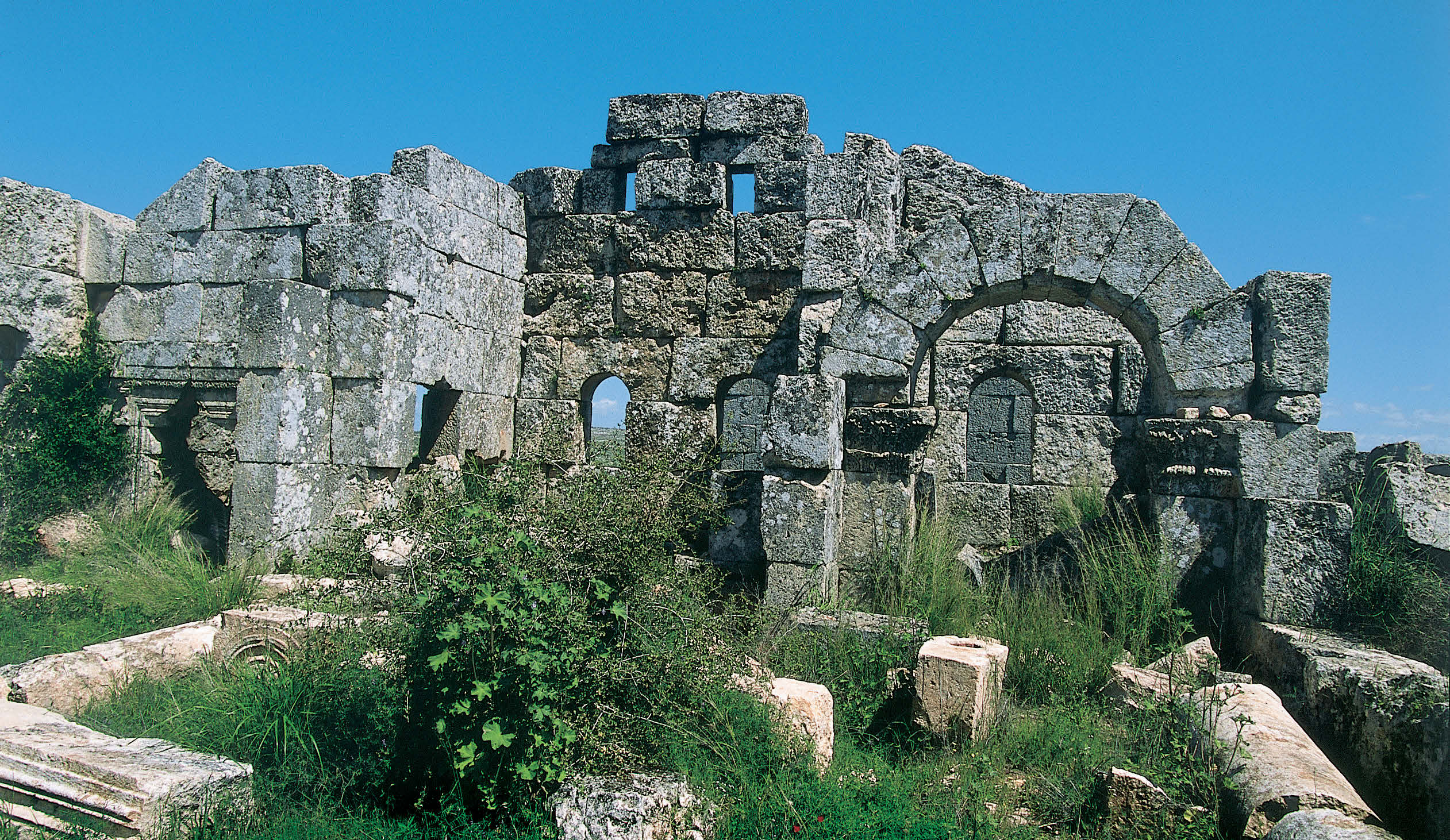
The church of Dehez in Syria may be one of the extremely rare Marcionite churches left. On the basis of an inscription found on the lintel of the baptistery, the philologist and diplomat Henri Pognon believed that the nave and the baptistery belonged to a Marcionite church, which was converted into a Christian church in the fifth century.16
叙利亚的代赫兹 (Dehez) 教堂可能是现存极为罕见的马吉安派 (Marcionite) 教堂之一。根据在洗礼堂门楣上发现的一则铭文,语文学家兼外交官亨利·波尼翁 (Henri Pognon) 认为,中殿和洗礼堂属于一座马吉安派 (Marcionite) 教堂,该教堂于五世纪被改建成一座基督教教堂。16
Tatian (c.110–180) faced the same task as Marcion: he needed to select orthodox works from the various gospels and letters of apostles then in circulation. He chose a method of reduction and around the year 170 assembled from the parallel works of the four Evangelists a Gospel harmony in the form of a running narrative of the life of Jesus, the Diatessaron. The Greek word means ‘from four’, indicating that he based his harmony exclusively on the four canonical gospels. The Syriac or Greek original has been lost. The oldest extant fragment, in Greek, came from Dura Europas and thus must be dated earlier than
塔提安 (Tatian,约110–180年) 面临着与马吉安 (Marcion) 相同的任务:他需要从当时流传的各种福音书和使徒书信中挑选出正统作品。他选择了一种删减的方法,并在约公元170年,从四位福音书作者的平行著作中汇编出一部福音合参,以耶稣生平的连贯叙事形式写成,即《四福音合参》 (Diatessaron)。这个希腊词意为“来自四部”,表明他的合参仅依据四部正典福音书。其叙利亚文或希腊文原文已佚失。现存最古老的残片为希腊文,出自杜拉-欧罗波斯 (Dura Europas),因此其年代必定早于
It is not without irony that the editor of the Diatessaron, some two years after the completion of his work, was condemned as a heretic. The cause of this was the strict asceticism, called Encratism, which he promoted. According to Tatian’s view, for instance, marriage was incompatible with the attainment of eternal life; only chaste Christians were true Christians.20 Independent of the question of whether the Encratites were heretical or orthodox Christians, they stood as the model for Syrian monasticism.
颇具讽刺意味的是,《四福音合参》(Diatessaron) 的编者在其著作完成约两年后,竟被判定为异端。其原因在于他所推崇的严格禁欲主义,即所谓的恩克拉提主义 (Encratism)。例如,按照塔提安 (Tatian) 的观点,婚姻与获得永生不相容;唯有守贞的基督徒才是真正的基督徒。20 无论恩克拉提派 (Encratites) 是异端还是正统基督徒,他们都成为叙利亚修道主义的典范。
Much evidence supports the claim that Christian asceticism arose not in Egypt – St Anthony re- nounced the world only around 285 – but rather an entire century earlier, in northern Mesopotamia.21 resurrection of the body, and his dualism made him a Docetist, since he taught that Jesus had no true body, as such a body would have been impure. Although Bardaisan adopted essential elements of Zoroastrianism, he, unlike Marcion, maintained belief in one God, as well as in the Trinity, which he understood as God the Father, Christ the Saviour and the Holy Spirit.28
大量证据支持这一主张:基督教禁欲主义并非起源于埃及 (Egypt)——圣安东尼 (St Anthony) 直到约285年才弃绝尘世——而是早整整一个世纪,起源于美索不达米亚北部 (northern Mesopotamia)。21 身体复活,而他的二元论使他成为幻影论者 (Docetist),因为他教导说耶稣没有真正的身体,因为这样的身体会是不洁的。尽管巴戴桑 (Bardaisan) 采纳了琐罗亚斯德教 (Zoroastrianism) 的基本要素,但他与马吉安 (Marcion) 不同,仍坚持信仰独一上帝,也信仰三位一体 (Trinity),他将其理解为圣父、救主基督和圣灵。28
Like his contemporary Tatian, Bardaisan (154–222), who was active in Edessa (one of the strongholds of Marcionism) battled the heresy of Marcion and likewise ended up a heretic. He emphasized the unity of the Christian God with the Creator God and that creation was good, that no taint of evil was inherent in matter. In contrast to Tatian, he rejected radical asceticism and acknowledged human free will.22 For Bardaisan, human beings, created in the image of God, possess a free will, which distinguishes them from the sun, moon and stars, as these are necessarily beholden to the laws of nature. Human beings can also overcome the influence of the stars – Bardaisan was very interested in astrological matters – and of fate. ‘If he [the human being] were so created that he could do no evil and thus could not receive blame, then the good that he did would also not be his own. For if he cannot do good or evil out of his own will, innocence or blame belongs to the fate that controls him.’23 Bardaisan denied the position that human beings were sinful by nature and thus anticipated a central aspect of East Syrian anthropology. ‘It follows, then, that we human beings are governed by nature in the same way and by fate in various ways, but, by means of our free will, each does as he chooses.’24
与同时代的塔提安 (Tatian) 一样,活跃于埃德萨 (Edessa)(马吉安主义 (Marcionism) 的据点之一)的巴戴桑 (Bardaisan, 154–222) 与马吉安 (Marcion) 的异端作斗争,最终也同样成了异端者。他强调基督教的上帝与造物主上帝的统一,并强调受造界是善的,物质中并不内在地含有恶的污点。与塔提安 (Tatian) 相反,他拒绝极端禁欲主义,并承认人的自由意志。22 对巴戴桑 (Bardaisan) 而言,按上帝形象受造的人拥有自由意志,这使他们有别于太阳、月亮和星辰,因为后者必然受自然法则的支配。人也能克服星辰——巴戴桑 (Bardaisan) 对占星事务极感兴趣——以及命运的影响。“如果他[人]被造得如此,以致不能作恶,因而不能受到责备,那么他所行的善也就不是他自己的。因为如果他不能出于自己的意志行善或作恶,那么清白或罪责就属于那控制他的命运。”23 巴戴桑 (Bardaisan) 否认人本性有罪这一立场,从而预示了东叙利亚人类学 (East Syrian anthropology) 的一个核心方面。“由此可知,我们人类以相同的方式受自然支配,以不同的方式受命运支配,但凭借我们的自由意志,各人按自己的选择行事。”24
The image of a female Holy Spirit was not uncommon in early Eastern Christian com- munities; we find this, for instance, in the Odes of Solomon in a Christian Gnostic hymnbook from the early third century and in the work of Aphrahat. In relation to the question of whether a man can serve two masters, namely God and wife, he concluded, ‘As long as a man has taken no wife, he loves and honours God his Father and the Holy Spirit his Mother and has no other attachment.’29
女性圣灵的形象在早期东方基督教群体中并不罕见;例如,我们在三世纪初一部基督教诺斯替派赞美诗集的《所罗门颂歌》(Odes of Solomon) 中,以及阿弗拉哈特 (Aphrahat) 的著作中,都能发现这一点。就一个人能否侍奉两位主人、即上帝和妻子这一问题,他总结道:“只要一个人尚未娶妻,他就爱并尊崇作为其父的上帝和作为其母的圣灵,且没有其他依恋。”29
Besides the Marcionites, Apollinarius of Laodicea and Christian Gnosticism were important exponents of Docetic theology. Gnosticism was not a unified doctrine but, rather, more like an eclectic world-view that appeared in the guise of various religions. Its philosophical kernel is found in Plato’s Phaidon and Politeia, according to which our earthly world represents merely the shadowy reflection of the real world of ideas.30 As a consequence of their disagreement with Zoroastrianism and Jewish apocalypticism, Gnostic thinkers radicalized the dualism implicit in Plato’s approach into the maximum alienation of the human being from the world and from him- or herself. The world and the human body no longer represented ‘only’ a false reflection of true reality but rather were both the wretched work of an evil and inferior demiurge. Only the pneuma, the spark of the soul, has the desire and also the possibility to leave the world of darkness and rise up to the highest God. Here knowledge of one’s own nature, gnosis, serves as the means of salvation; in Christian Gnosticism, Christ takes on the task of calling the chosen and leading them
除马吉安派 (Marcionites) 外,老底嘉的阿波利拿里 (Apollinarius of Laodicea) 与基督教诺斯替主义 (Christian Gnosticism) 也是幻影说神学 (Docetic theology) 的重要代表。诺斯替主义 (Gnosticism) 并非一种统一的教义,而更像是一种以各种宗教为外衣出现的折衷主义世界观。其哲学内核见于柏拉图的《斐多篇》(Phaidon) 和《理想国》(Politeia);按照这种观点,我们的尘世世界仅仅代表着真正理念世界的影子式反映。30 由于与琐罗亚斯德教 (Zoroastrianism) 和犹太启示论 (Jewish apocalypticism) 存在分歧,诺斯替思想家将柏拉图式进路中隐含的二元论激进化,使之成为人同世界以及人同自身之间的最大异化。世界和人的身体不再“仅仅”是对真正现实的虚假反映,而二者都是邪恶而低劣的巨匠造物主 (demiurge) 的可悲作品。只有普纽玛 (pneuma),即灵魂的火花,才既怀有离开黑暗世界并上升至至高神的渴望,也具备这种可能性。在这里,对自身本性的认识,即灵知 (gnosis),充当得救的手段;在基督教诺斯替主义 (Christian Gnosticism) 中,基督 (Christ) 承担起召唤蒙拣选者并引领他们的任务
Bardaisan, who likewise had his own edition of the Gospel text, which cannot be reconstructed today,25 took an interest in Chaldean astrology and its dualistic cosmogony. Like the later Mani, Bardaisan saw creation as the result of a mixing of good with evil. The path to freeing the soul from the prison of the body – that is, the sifting out of the good from the impure – passes over observ- ance of God’s law.26 As a sign supporting the principle of the good, Bardaisan’s followers wore white.27 Bardaisan’s plan for salvation excluded the
巴戴桑 (Bardaisan) 同样拥有自己版本的福音文本,该文本如今已无法重构,25 他对迦勒底占星术及其二元论宇宙起源论很感兴趣。像后来的摩尼 (Mani) 一样,巴戴桑认为创造是善与恶混合的结果。将灵魂从肉体牢狱中解放出来的道路——也就是从杂质中筛出善——绕开了对上帝律法的遵守。26 作为支持善之原则的标志,巴戴桑的追随者身穿白衣。27 巴戴桑的救赎计划排除了
to the saving knowledge. Christian Gnostics of the second century, such as, e.g., Satoril, Carpocrates, Cerdon and, above all, Cerinth, distinguished not only between the inferior Creator God and the distant, highest God, but also between the mortal Jesus and the impassible Christ.31 As has been mentioned, East Syrian Christology reaches a comparable conclusion, although it begins with entirely different assumptions and uses different concepts. While it emphasizes the ontological unity of Christ, it also states, like Greek Orthodoxy, that he suffered and died as man, not as God. a two-nature doctrine of Christ, called dyophysit- ism, since this threatened the conceptual unity of Christ, so he suggested a new way. Like most theologians of his time, Apollinarius subscribed to the Platonic view that the human being consisted of body, soul and spirit (will). Applying this model to Jesus, Apollinarius objected above all to Arius’s opinion that Jesus’s will would have been able to sin. In order to protect the fundamental sinless- ness of Jesus, he declared that in Jesus the divine Logos took the place of a human will. Thus Apollinarius denied Jesus the experience of moral development, since the Word-made-flesh was perfect and unchangeable.32
引向得救的知识。二世纪的基督教诺斯替派,例如萨托里尔 (Satoril)、卡尔波克拉底 (Carpocrates)、塞尔东 (Cerdon),尤其是克林妥 (Cerinth),不仅区分了低等的造物主神与遥远的至高神,还区分了会死的耶稣与不能受苦的基督。31 如前所述,东叙利亚基督论得出了类似的结论,尽管它从完全不同的前提出发,并使用不同的概念。尽管它强调基督在本体论上的统一,它也像希腊正教一样声称,他是作为人、而非作为神受苦并死亡。由于一种被称为二性论 (dyophysitism) 的基督二性学说威胁到基督在概念上的统一性,他提出了一条新途径。像他那个时代的大多数神学家一样,阿波利拿里 (Apollinarius) 赞同柏拉图的观点,即人由身体、灵魂和灵(意志)组成。将这一模型应用于耶稣时,阿波利拿里尤其反对阿里乌 (Arius) 的观点,即耶稣的意志本可能犯罪。为了保护耶稣根本上的无罪性,他宣称,在耶稣里面,神圣的逻各斯 (Logos) 取代了人的意志。因此,阿波利拿里否认耶稣有道德发展的经历,因为道成肉身者是完美且不变的。32
Christian theologians such as Tertullian (c.160–225), Irenaeus (c.140–202) and Hippolytus (c.170–236) argued against the Gnostics as follows. There is only one God, who created the world, which is inherently good, so the acceptance of a second, inferior, demiurge is absurd. Yet more absurd are the cosmological speculations of the Gnostics and their conviction that the path of salvation led not over the redeeming work of Christ carried out on the cross but rather over a secret knowledge accessible to only a small elite. The salvation of Christ is not restricted to an elite but, rather, is open to all people who believe in him and his message. It should also be noted that, although early Christianity overcame Gnosticism, it was nonetheless influenced by its disparagement of and contempt for the material and corporeal. Like numerous adherents of Marcion and Bardaisan, many Gnostics found a new home in Manichaeism from the mid-third century onwards.
诸如德尔图良 (Tertullian,约160—225年)、爱任纽 (Irenaeus,约140—202年) 和希波吕托斯 (Hippolytus,约170—236年) 等基督教神学家,曾如下反驳诺斯替派 (Gnostics)。只有一位神,他创造了世界,而世界本质上是善的,因此接受一位第二位、次等的造物主 (demiurge) 是荒谬的。然而更荒谬的是诺斯替派 (Gnostics) 的宇宙论思辨,以及他们坚信:救赎之路并非经由基督 (Christ) 在十字架上完成的救赎工作,而是经由只有少数精英才能获得的秘密知识。基督 (Christ) 的救恩并不局限于精英,而是向所有相信他和他的信息的人开放。还应指出,尽管早期基督教战胜了诺斯替主义 (Gnosticism),却仍受到其贬低和蔑视物质与肉体之倾向的影响。与马吉安 (Marcion) 和巴戴桑 (Bardaisan) 的众多追随者一样,许多诺斯替派 (Gnostics) 自三世纪中叶起在摩尼教 (Manichaeism) 中找到了新的归宿。
As will be explained below,33 the Asian Greeks Diodore of Tarsus and Theodore of Mopsuestia, who are recognized as Church Fathers by the East Syrians, opposed this approach, since in it the human nature of Christ all but withered away. If one followed Apollinarian doctrine, Christ possessed only a human body and a human soul, but no human spirit. In this case, Jesus had no authentic human nature, which called into question his saving work, since the salvation of humanity presumed the full acceptance of human nature by Christ. Although the Second Ecumenical Council of Constantinople con- demned the teaching of Apollinarius in 381, the Miaphysite (one-nature) formula of the bishop of Laodicea remained in circulation and laid the groundwork in the middle of the next century for the extreme monophysitism of Eutyches (378–454).
如下文将解释的那样,33 亚细亚的希腊人塔尔苏斯的狄奥多若 (Diodore of Tarsus) 和摩普苏埃斯蒂亚的狄奥多雷 (Theodore of Mopsuestia),被东方叙利亚人 (East Syrians) 尊为教父,他们反对这一进路,因为在这种进路中,基督的人性几乎消失殆尽。如果遵循阿波利拿里派教义 (Apollinarian doctrine),基督便只拥有人的身体和人的灵魂,却没有人的灵。在这种情况下,耶稣没有真正的人性,这使他的救赎工作受到质疑,因为人类的得救以基督完全接纳人性为前提。尽管第二次君士坦丁堡大公会议 (Second Ecumenical Council of Constantinople) 于381年谴责了阿波利拿里 (Apollinarius) 的教导,老底嘉主教 (bishop of Laodicea) 的米亚弗西派(一性)公式 (Miaphysite formula) 仍在流传,并在下一世纪中叶为优提克斯 (Eutyches, 378–454) 的极端一性论 (extreme monophysitism) 奠定了基础。
Since Christianity was, by 381/392 at the latest, the state religion of the Roman Empire, conciliar decisions served as civil laws, as soon as the emperor ratified them. Local bishops were the first to perceive this, as they were obligated to uphold the opinions declared orthodox by the councils. Opposition to conciliar pronounce- ments led to civil sanctions; dissenting bishops were sent into exile and replaced with orthodox ones. However, since the bishops often had at their disposal a strong following, dismissal by force could not be carried out immediately, for
由于至迟在381/392年,基督教已成为罗马帝国的国教,公会议决议一旦获得皇帝批准,便具有民事法律效力。地方主教最先察觉到这一点,因为他们有义务维护公会议宣布为正统的观点。反对公会议声明会招致民事制裁;持异议的主教被流放,并由正统主教取而代之。然而,由于主教们往往拥有强大的追随者,以武力将其罢免无法立即实施,因为
The doctrine of Apollinarius of Laodicea (c.310–390), which was directed against Arianism, had significant consequences for the history of early Christianity and for the patriarchate of Antioch. Bishop Apollinarius, together with his theological opponent, the Church Father Diodore of Tarsus (†392), was one of the first to shift the focus of the theological debate on the Trinity to the understanding of the nature(s) of Christ. He was concerned about the Diodoran approach of
老底嘉的阿波利拿里 (Apollinarius of Laodicea) 的学说(约310–390年)针对阿里乌主义 (Arianism),对早期基督教历史以及安提阿宗主教区 (patriarchate of Antioch) 产生了重大影响。阿波利拿里主教 (Bishop Apollinarius) 与其神学对手、教父塔尔苏斯的狄奥多若 (Diodore of Tarsus, †392) 一道,是最早将关于三位一体 (Trinity) 的神学辩论焦点转向对基督本性 (nature(s) of Christ) 之理解的人之一。他关注的是狄奥多若式的进路,即
the threat of revolt was too great. This was all the truer when, in the traditional hotbeds of unrest in the patriarchs of Alexandria and Antioch, an anti-Byzantine nationalistic reflex arose. During the tumult of that time there were many casual- ties, and, in the case of the Melkite patriarch of Alexandria, Proterios, even murder: an angry mob killed the unfortunate patriarch in 457 in the baptistery of his cathedral.34 Other prominent victims were Flavian, the deposed archbishop of Constantinople, who was so badly injured by monks and soldiers at the so-called ‘Robber Synod’ of 449 that he died of his wounds three days later; and Bishop Severian of Scythopolis, who was murdered in 451 on the return from Chalcedon.35 For these reasons, in the large cities communities often remained divided, each with their own clergy and their own churches. Although canon law assigned only one bishop per city, for a time Antioch had four vying for power! It was in this patriarchate that the battles between Miaphysites, Dyophysites and Melkites loyal to the emperor raged most fiercely. and Christianity. A critical retrospective of two millennia of Christology also reminds us that it always remains ‘Christo-Logy’, human talk about Jesus Christ, which is embedded in the social, cultural and political context of its time.
叛乱的威胁实在太大。当在亚历山大里亚 (Alexandria) 和安条克 (Antioch) 牧首区这些传统的动荡温床中,出现一种反拜占庭的民族主义本能反应时,情况就更是如此。在那段时期的骚乱中,有许多人丧生;就亚历山大里亚的梅尔基特派 (Melkite) 牧首普罗特里奥斯 (Proterios) 而言,甚至遭到谋杀:一群愤怒的暴民于457年在他主教座堂的洗礼堂中杀死了这位不幸的牧首。34 其他著名的受害者还有被废黜的君士坦丁堡 (Constantinople) 大主教弗拉维安 (Flavian),他在449年所谓的“强盗会议” (Robber Synod) 上被修士和士兵打得伤势极重,三天后因伤而死;以及斯基托波利斯主教塞维里安 (Severian of Scythopolis),他于451年从迦克墩 (Chalcedon) 返回途中被谋杀。35 由于这些原因,在大城市中,社群往往仍然处于分裂状态,各自拥有自己的神职人员和自己的教堂。尽管教会法规定每座城市只应有一位主教,但有一段时间,安条克竟有四位主教争夺权力!正是在这个牧首区,一性论者 (Miaphysites)、二性论者 (Dyophysites) 和效忠皇帝的梅尔基特派 (Melkites) 之间的斗争最为激烈。以及基督教。对两千年基督论进行批判性回顾也提醒我们,它始终是‘基督—逻各斯’ (Christo-Logy),即关于耶稣基督的人之言说,而这一言说嵌入在其时代的社会、文化和政治语境之中。
Christianity becomes the Roman state Church
基督教成为罗马国教
There are various dates that could mark the start of Christianity as the Roman state Church. In 312, after his victory in the battle of the Milvian Bridge, Emperor Constantine I (ruled 312–337) declared himself a Christian; in the following year he proclaimed the Edict of Milan, which guaranteed religious freedom.37 Since the emperor pronounced the Christian god as his god, this god was elevated, eo ipso, to the god of the empire. With Emperor Theodosius I (ruled 379–395), the process of the Christianization of the Roman state, begun with Emperor Constantine, led to a nationalization of the Church when, in 381, he forbade the conversion from Christianity to another religion and then, ten years later, put an end to all pagan worship within the empire and had the pagan temples destroyed or turned into churches. However, Constantine’s successors had already banned pagan sacrifices in 341, and in 346 had decreed the closing of pagan temples, although in 361 Emperor Julian the Apostate (ruled 361–363) undertook the last, unsuccessful, attempt to create a Christian–pagan synthesis and had the closed temples reopened.38
有若干日期都可被视为基督教成为罗马国教的开端。312年,皇帝君士坦丁一世 (Constantine I)(在位 312–337 年)在米尔维安桥战役 (Battle of the Milvian Bridge) 获胜后,宣布自己为基督徒;次年,他颁布了保障宗教自由的《米兰敕令》(Edict of Milan)。37 既然皇帝宣称基督教的神为自己的神,这位神便因此 (eo ipso) 被提升为帝国的神。在皇帝狄奥多西一世 (Theodosius I)(在位 379–395 年)治下,自君士坦丁皇帝开始的罗马国家基督教化进程导致了教会的国有化:381年,他禁止从基督教改宗其他宗教;十年后,他又终止了帝国境内的一切异教崇拜,并下令摧毁异教神庙或将其改建为教堂。然而,君士坦丁的继任者早在341年就已禁止异教献祭,并于346年下令关闭异教神庙;不过,361年,背教者尤利安皇帝 (Julian the Apostate)(在位 361–363 年)进行了最后一次不成功的尝试,试图创造基督教与异教的融合,并下令重新开放已关闭的神庙。38
However, the intensity of these theological disputes – unimaginable to us in the twenty-first century – cannot be explained just on the basis of political circumstances. As W. Klein has aptly stated, at that time ‘dogma was not yet the specialized science of a few theologians, but rather the stuff of everyday conversation, and it resembled modern disputes over party politics’.36 Finally, the question arose of whether Christian dogma could be brought into agreement with the scholarship of the time – that is, Hellenistic philosophy. Of concern was the project of describing and clarifying Christian doctrine, particularly the incarnation of Christ, with the help of philosophical concepts. The solutions worked out in this formative period remained valid in their important characteristics until the early Renaissance, when the redefinition of the parameters of scholarship radically called into question the alleged compatibility of scholarship
然而,这些神学争论的激烈程度——对21世纪的我们而言难以想象——不能仅从政治环境的角度来解释。正如 W. 克莱因 (W. Klein) 所恰当指出的,当时“教义尚未成为少数神学家的专门学问,而是日常交谈的内容,并且类似于现代关于党派政治的争论”。36 最后,出现了这样一个问题:基督教教义能否与当时的学术——即希腊化哲学——相协调。所关切的是借助哲学概念来描述和阐明基督教教义,尤其是基督的道成肉身。在这一形成期所制定的解决方案,其重要特征一直有效,直到文艺复兴早期;当时,对学术研究参数的重新界定从根本上质疑了所谓的学术相容性
It is hardly surprising that the Christian Church first expressed thanks for its sudden recognition as the state religion with a certain submissive- ness and gladly accepted ‘golden chains’ in the form of financial support from the state. Because Constantine wanted to defend the threatened unity of the empire with a common religion, he laid great importance on the unity of doctrine within the Church – thus setting an example for
基督教会最初以某种顺从的姿态,对其突然被承认为国教表达感谢,并欣然接受国家以财政支持形式提供的“金锁链”,这几乎不足为奇。因为君士坦丁 (Constantine) 想以一种共同的宗教来捍卫帝国受到威胁的统一,他极为重视教会内部教义的一致——从而为……树立了榜样
his successors. For this reason, he convened the Synod of Rome in 313 to resolve the problem of the North African Donatists and the Council of Nicea in 325 to stem the tide of Arianism. The extent to which the ecclesiastical leadership made concessions to the emperor is shown by the following decision of the Council of Arles from 314: ‘Those who surrender their weapons in peacetime shall not take communion.’39 Official Christianity had deviated so significantly from the radical pacifism of Jesus that it excluded from the Eucharist those who refused military service! valid. Now theological discourse was subject to state censorship. The closing of the school of philosophers in Athens in 529 further reduced freedom of opinion, and as a consequence the West gradually lost its Hellenistic heritage. Heterodox Christians and pagans were from then on abominable criminals, who had to be dealt with by civil justice. The persecution of heterodox Christians began on a large scale in 431 with the oppression of the followers of Nestorius in the patriarchate of Antioch, and reached a tragic zenith with the Inquisition. It was again the Nestorians who, towards the end of the Inquisition, fell victim to it; in 1599 the Nestorian Thomas Christians of Kerala were forcibly converted to Catholicism by the Inquisition and had their entire written heritage burned.
他的继任者。为此,他于313年召集了罗马会议 (Synod of Rome),以解决北非多纳图派 (Donatists) 的问题,并于325年召开尼西亚公会议 (Council of Nicea),以遏制阿里乌主义 (Arianism) 的浪潮。教会领导层对皇帝作出让步的程度,可由314年阿尔勒会议 (Council of Arles) 的以下决定看出:“那些在和平时期交出武器的人,不得领受圣餐 (communion)。”39 官方基督教已经如此严重地偏离了耶稣的激进和平主义,以至于它将那些拒绝服兵役的人排除在圣体圣事 (Eucharist) 之外!有效。如今,神学话语受到国家审查。529年雅典哲学学校 (school of philosophers in Athens) 的关闭进一步压缩了意见自由,其后果是西方逐渐失去了其希腊化遗产。从那时起,异端基督徒和异教徒成了可憎的罪犯,必须由民事司法来处置。对异端基督徒的迫害于431年大规模开始,当时安条克牧首区 (patriarchate of Antioch) 内聂斯托利 (Nestorius) 的追随者遭到压制,并在宗教裁判所 (Inquisition) 时期达到悲剧性的顶峰。在宗教裁判所 (Inquisition) 末期,再次沦为受害者的正是聂斯托利派 (Nestorians);1599年,喀拉拉 (Kerala) 的聂斯托利派圣多马基督徒 (Nestorian Thomas Christians) 被宗教裁判所 (Inquisition) 强行改宗天主教 (Catholicism),其全部书面遗产也被焚毁。
The Council of Nicea also established the division of the Church into metropolitan sees, which assigned the bishops of their respective provinces. Rome was the metropolitan see for the West, Alexandria for Egypt and Libya, and Antioch for the parts of Asia belonging to the Roman Empire. The Council of Constantinople of 381 granted the metropolitan see of Constantinople precedence over those of Antioch and Alexandria, since Constantinople was the ‘new Rome’.40 The primacy of the bishop of Rome, however, estab- lished under Pope Damasus (in office 366–384), remained unchanged.41 Finally, in 451, the Council of Chalcedon elevated Jerusalem to a patriarchal see as well, thus creating the so-called pentarchy. It was made up of five patriarchates, listed here by rank: Rome, Constantinople, Alexandria, Antioch and Jerusalem.42 However, the pentarchy applied only to the Christian world within the empire and pertained to neither the autonomous Churches beyond the imperial borders, such as, e.g., that of Armenia or the Church of the East, nor the Arian Churches of the Germanic peoples, such as, e.g., the Goths and Vandals. With the Arab conquest of Egypt and the Middle East in the seventh century, the patriarchates of Alexandria, Antioch and Jerusalem lost most of their importance.
尼西亚公会议 (Council of Nicea) 还确立了将教会划分为都主教教座的做法,各教省的主教由此归属相应的都主教教座。罗马是西方的都主教教座,亚历山大里亚 (Alexandria) 是埃及和利比亚的都主教教座,安条克 (Antioch) 则是属于罗马帝国的亚细亚各地区的都主教教座。381年的君士坦丁堡公会议 (Council of Constantinople of 381) 赋予君士坦丁堡 (Constantinople) 都主教教座优先于安条克和亚历山大里亚都主教教座的位次,因为君士坦丁堡是“新罗马” (new Rome)。40 然而,罗马主教的首席权在教皇达马苏 (Pope Damasus)(在位 366–384 年)任内确立后,仍保持不变。41 最后,在 451 年,迦克墩公会议 (Council of Chalcedon) 也将耶路撒冷 (Jerusalem) 提升为宗主教教座,从而形成了所谓的五牧首制 (pentarchy)。它由五个宗主教区组成,按位次排列如下:罗马、君士坦丁堡、亚历山大里亚、安条克和耶路撒冷。42 然而,五牧首制仅适用于帝国内的基督教世界,既不涉及帝国边界之外的自主教会,例如亚美尼亚教会 (Armenia) 或东方教会 (Ch. of E.),也不涉及日耳曼诸民族的阿里乌派教会,例如哥特人 (Goths) 和汪达尔人 (Vandals)。随着七世纪阿拉伯人征服埃及和中东,亚历山大里亚、安条克和耶路撒冷的宗主教区失去了其大部分重要性。
A jubilee address of the church historian Eusebius of Caesarea reveals the emperor’s vision of close ties between the Church and the civil power structure. In it Eusebius lauds the emperor as the earthly likeness of the heavenly ruler, on whose behalf he rules.43 He thus anti- cipated the instrumentalization of Buddhism practised by several dynasties in ancient China, according to which the emperor was the likeness of the Buddha Vairocana or Maitreya and his representative on Earth.44 This vision of Emperor Constantine also explains his personal interest in the defeat of Arianism, since it threatened his position as the divinely blessed emperor. If Jesus was, in the end, merely a human being adopted by God, what special claim could the emperor make? Despite its proximity to worldly power, the Church did not allow itself to be reduced to a handmaiden of the state. The institution of the papacy prevented a union of personnel of ecclesiastical and civil power and established an unstable balance between the two authorities, which was continually being redefined. Thanks to this relative independence and the fact that the emperor no longer lived in Rome, the Church was barely affected by the collapse of the Western
教会历史学家凯撒利亚的优西比乌 (Eusebius of Caesarea) 的一篇禧年演说,揭示了皇帝关于教会与世俗权力结构之间紧密联系的构想。在演说中,优西比乌称赞皇帝是天上统治者的地上肖像,皇帝代表这位天上统治者进行统治。43 他由此预见了中国古代若干王朝对佛教的工具化利用:按照这种观念,皇帝是毗卢遮那佛 (Vairocana) 或弥勒佛 (Maitreya) 的化身,是其在世间的代表。44 君士坦丁大帝 (Constantine) 的这一构想,也解释了他为何亲自关注击败阿里乌主义 (Arianism),因为阿里乌主义威胁到他作为蒙神赐福的皇帝的地位。如果耶稣归根结底只是一位被上帝收养的人,那么皇帝还能提出什么特殊主张呢?尽管教会与世俗权力关系密切,它并不容许自己沦为国家的婢女。教宗制 (papacy) 阻止了教会权力与世俗权力在人员上的合一,并在两种权威之间建立了一种不断被重新界定的不稳定平衡。由于这种相对独立性,以及皇帝不再住在罗马 (Rome) 这一事实,教会几乎未受西部崩溃的影响。
The decrees of Theodosius brought an end to religious freedom in the Roman Empire, and the Council of Constantinople, which he convened, established the creed of Nicea as universally
狄奥多西 (Theodosius) 的法令终结了罗马帝国 (Roman Empire) 的宗教自由,而他召集的君士坦丁堡公会议 (Council of Constantinople) 将《尼西亚信经》(Creed of Nicea) 确立为普世
were called Monophysites (‘one’ and ‘nature’) or Miaphysites, since they taught a union of the two natures.47 Because the non-Chalcedonian churches, such as the Syrian Orthodox and Coptic Church, reject the description ‘monophysite’, as it more accurately suits the one-nature doctrine of Eutyches, we will use the term ‘miaphysite’, which they adopted from the Mia-Physis formula used by Patriarch Cyril of Alexandria.48 The Western patriarch of Rome finally referred to Tertullian, who spoke of two natures in one person of Christ and thus stood close to the Antiochene position.
他们被称为一性论者(Monophysites,意为“一”与“本性”)或合性论者(Miaphysites),因为他们教导两种本性的联合。47 由于非迦克墩教会 (non-Chalcedonian churches),如叙利亚正教会 (Syrian Orthodox Church) 和科普特教会 (Coptic Church),拒绝“一性论者” (monophysite) 这一称谓,因为它更准确地适用于优提克斯 (Eutyches) 的一性论,我们将使用“合性论者” (miaphysite) 这一术语,该词源于亚历山大的宗主教西里尔 (Cyril of Alexandria) 所使用的“一性”(Mia-Physis)公式。48 罗马 (Rome) 的西方宗主教最终援引了德尔图良 (Tertullian),后者论及基督一个位格中的两种本性,因而与安提阿学派 (Antiochene) 的立场相近。
Roman Empire. The shift of the imperial capital to Constantinople in 330 freed the bishop of Rome from the threat of state control.
罗马帝国 (Roman Empire)。330年,帝国首都迁至君士坦丁堡 (Constantinople),使罗马主教 (bishop of Rome) 摆脱了国家控制的威胁。
In short order, Christianity’s elevation to Roman state religion brought to the fore the explosive question of the status of those Christians who lived outside the imperial borders, especially if they belonged to states hostile to Rome. The Christians east of the Euphrates soon learned the painful answer.45
很快,基督教被提升为罗马国教,这使那些生活在帝国边界之外的基督徒的地位问题凸显出来,成为一个爆炸性的问题,尤其是当他们属于与罗马 (Rome) 为敌的国家时。幼发拉底河 (Euphrates) 以东的基督徒很快就领受了痛苦的答案。45
The foundations of East Syrian theology
东叙利亚神学的基础
The term ‘School of Antioch’ ought not be understood as designating an unchanging doctrinal position but rather a certain method of biblical interpretation, strongly marked by reflections on the nature of Jesus. The school of thought of Antioch proceeded along text-critical and historical lines, paying close attention to the literal words of Scripture, in contrast to the School of Alexandria, which interpreted the Bible allegorically. The exegetes of Antioch were influenced by the Greek bishops Diodore of Tarsus (†392) and Theodore of Mopsuestia (352–428), who both belonged to the patriarchate of Antioch and wrote in the struggle against the Miaphysite position of Apollinarius. Diodore’s first principle was: ‘We strongly prefer the his- torical to the allegorical.’49 By contrast, allegorical exegesis, developed by Clement (c.150–215) and Origen (c.185–254), looked behind the biblical text for another, second, sense, which had no inherent connection to the literal content, as is the case with symbols. Roughly speaking, the exegesis of Antioch is rational, synoptic and Aristotelian, and that of Alexandria is mystical- allegorical, Platonic and Johannine.
“安提阿学派 (School of Antioch)”这一术语不应被理解为指称一种一成不变的教义立场,而应被理解为一种特定的圣经解释方法,其显著特征是对耶稣本性的反思。安提阿的思想流派沿着文本批判与历史的路线展开,密切关注圣经的字面词句,与亚历山大里亚学派 (School of Alexandria) 形成对照,后者以寓意方式解释圣经。安提阿的解经家受到希腊主教塔尔苏斯的狄奥多雷 (Diodore of Tarsus)(†392)和摩普苏埃斯蒂亚的狄奥多雷 (Theodore of Mopsuestia)(352–428)的影响;二人均属于安提阿宗主教区 (patriarchate of Antioch),并在反对阿波利拿里 (Apollinarius) 的合性论 (Miaphysite) 立场的斗争中写作。狄奥多雷的首要原则是:“我们强烈偏好历史性的解释,而非寓意性的解释。”49 相比之下,由克莱门特 (Clement)(约150–215)和奥利金 (Origen)(约185–254)发展出的寓意解经,则在圣经文本背后寻找另一种、第二重意义,这种意义与字面内容没有内在联系,正如符号的情形一样。大致而言,安提阿的解经是理性的、综观式的和亚里士多德式的,而亚历山大里亚的解经则是神秘—寓意的、柏拉图式的和约翰式的。
The Church Fathers Diodore of Tarsus and Theodore of Mopsuestia
教父塔尔苏斯的狄奥多若 (Diodore of Tarsus) 与摩普苏埃斯蒂亚的狄奥多雷 (Theodore of Mopsuestia)
The attempt to define the nature of Jesus Christ is a truly Herculean labour, for it requires finding a common denominator between the mutually exclusive concepts of complete God and complete man. In addressing this question, the choice of starting point has a decisive effect on the chain of reasoning. At that time, as Nestorius noted, the theologians of the Eastern patriarchates, who argued about a Christological creed, were adherents of either the School of Antioch or the School of Alexandria. Supporters of the former proceeded from the historical person of Jesus, as he is portrayed in the Synoptic Gospels, and then tried to understand how this man Jesus could simultaneously be God. The latter group, by contrast, began with the Word of God from the prologue of the Gospel of John and tried to understand what it meant that the Word became flesh.46 The former laid the greatest significance on the wholeness of the human dimension of Jesus, while the latter emphasized his divinity. Because the Antiochenes spoke of two complete natures of Christ, they were called Dyophysites (from the Greek ‘dyo’ and ‘physis’, two and natures); the Alexandrians, on the other hand,
试图界定耶稣基督的本性,实在是一项艰巨无比的工作,因为这需要在“完全的上帝”与“完全的人”这两个彼此排斥的概念之间找到一个共同点。在探讨这一问题时,起点的选择对推理链条具有决定性影响。当时,正如聂斯脱利 (Nestorius) 所指出的,那些争论基督论信条的东方各宗主教区的神学家,要么属于安提阿学派 (School of Antioch),要么属于亚历山大里亚学派 (School of Alexandria)。前者的支持者从对观福音书 (Synoptic Gospels) 中所描绘的历史上的耶稣其人出发,进而试图理解这个名为耶稣的人如何能够同时是上帝。后者则相反,从《约翰福音》(Gospel of John) 序言中的上帝之道出发,试图理解道成肉身意味着什么。46 前者最重视耶稣人性维度的完整性,而后者则强调他的神性。由于安提阿派谈论基督的两个完整本性,他们被称为二性论者 (Dyophysites)(源自希腊语“dyo”和“physis”,即“二”和“本性”);而亚历山大里亚派则……
As far as Christology is concerned, it is obvious that historical exegesis emphasizes the human dimension of Christ and thus favours a sharp distinction between the divine and human natures. It was necessary to avoid the later Miaphysite position, the belief that, in Christ,
就基督论而言,显然,历史释经强调基督的人性维度,因而倾向于对神性与人性作出鲜明的区分。必须避免后来的一性论 (Miaphysite) 立场,即认为在基督里,
‘the humanity was absorbed by the divinity, like a drop of honey dissolved in the sea’.50 Eustathius of Antioch (†337) stands as founder of the historical Christological approach. He character- ized Christ as a ‘God-bearing man’, who freely decided to obey the wish of God the Father and take upon himself death on the cross.51 Thus, as the human being, acting out of free will, either obeys the law of God or turns away from Him and commits sin, Jesus Christ took upon himself the work of salvation. subject to the human being’s own limits and weaknesses, he redeemed them with the resur- rection and granted to them the attributes of divinity. He thus opened the way for human beings to do like him.
“人性被神性所吸收,就像一滴蜂蜜消融于大海之中。”50 安条克的尤斯塔修斯 (Eustathius of Antioch)(†337)是历史基督论进路的奠基人。他将基督描述为“承载上帝的人” (God-bearing man),他自由地决定顺服父神的旨意,并亲自承担十字架上的死亡。51 因此,正如人凭自由意志行事,或遵行上帝的律法,或背离他而犯罪,耶稣基督承担了救赎之工。他受人类自身局限和软弱的制约,以复活救赎了他们,并将神性的属性赐予他们。他由此为人类开辟了效法他的道路。
Even though Diodore underlined the whole- ness of the humanity of Jesus and his soul, he also maintained his complete divinity; for him, the two natures exist side by side, without mixing. As a consequence of the presumed separation, Diodore could attribute a moral development to the human soul of Jesus, which attained perfection by means of the action of the Holy Spirit in his baptism in the Jordan, and could, at the same time, avoid ascribing suffering and death to the divinity. He thus opposed the so- called Theopaschites, who attributed suffering and death to the Son of God. ‘We will not allow ourselves to be misled into believing that the God Logos suffered. It was rather the child of Mary, to whom sonship was granted, the temple of the God-Logos, who was destroyed by the Jews, from which, however, the one who lived therein arose.’54 It is clear from this statement that, for Diodore, one suffered death and another rose from it – an idea which runs as a leitmotif through Nestorian Christology. On this matter he could rely on Athanasius, the leading Church Father at the Council of Nicea. Since ‘it was impossible for the Word to suffer death, being immortal, the Son of the Father takes to himself a body capable of death’.55 The image of the indwelling of the divine nature in the visible person of Jesus was very popular among the Nestorians. As the fourteenth-century Book of the Tower maintained, ‘The divinity and the humanity were united in the visible temple [Jesus].’ In another passage we can read the following poetic metaphor: ‘God sent his Word in a paper wrapping, which was the human being [Jesus], to show humanity the path of faith.’56 The crux of this approach is found in the definition of how the two natures, the Son of God and the
尽管狄奥多若 (Diodore) 强调了耶稣 (Jesus) 的人性及其灵魂的完整性,他也坚持其完全的神性;对他而言,两种本性并存,不相混合。由于这种被假定的分离,狄奥多若可以将一种道德发展归给耶稣的人性灵魂,这灵魂借着圣灵 (Holy Spirit) 在他在约旦河 (Jordan) 受洗时的作用而达到完全,同时又能避免把受苦与死亡归给神性。他因此反对所谓的神受难派 (Theopaschites),该派把受苦与死亡归给上帝之子 (Son of God)。“我们不会让自己被误导,以致相信上帝圣言 (God Logos) 受了苦。相反,乃是马利亚 (Mary) 的孩子,他被赐予儿子的名分,是上帝圣言 (God-Logos) 的殿,被犹太人 (Jews) 所毁,然而住在其中的那一位却从这殿中兴起。”54 从这一陈述可以清楚看出,对狄奥多若而言,一个受死,另一个从其中兴起——这一观念作为主导动机贯穿聂斯脱利派基督论 (Nestorian Christology)。在这一点上,他可以依据尼西亚公会议 (Council of Nicea) 的首要教父阿塔那修 (Athanasius)。因为“圣言 (Word) 既是不朽的,就不可能受死,父之子 (Son of the Father) 便为自己取了一个能死的身体”。55 神性内住于耶稣可见位格之中的意象,在聂斯脱利派 (Nestorians) 中非常流行。正如十四世纪的《塔之书》(Book of the Tower) 所主张的:“神性与人性在可见的圣殿 [耶稣] 中联合了。”在另一段中,我们可以读到如下诗意的隐喻:“上帝把他的圣言 (Word) 包在纸包裹里,这纸包裹就是那个人 [耶稣],为要向人类指明信仰之路。”56 这一进路的关键在于对以下问题的界定:两种本性,即上帝之子与
That the salvation of humanity is impossible without Christ’s full possession of human nature and the simultaneous preservation of his full divinity was also the conviction of the power- fully eloquent bishop of Constantinople, John Chrysostom (347–407). ‘Hell will spit out those who assert that our Lord Jesus Christ [after the union of the two natures] has only one nature. Now, which nature do they destroy? If the divine, then there is no salvation. If the human, then humanity loses all hope of eternal life.’52 The significance of the absolute wholeness of both natures in Christ is evident when seen against the background of belief in bodily salvation, which plays a central role in the Syrian Churches in general and in the Church of the East in particular. Its essence consists in the human being approaching and approximating the divine, a concept which unimaginably raises the value of humanity. St Athanasius (292–373) neatly expressed the idea that God’s becoming flesh implied the divinization of human beings: ‘He [the Word of God] became man, so that we might become God.’53
若没有基督对人性之完全拥有以及对其完全神性之同时保全,人类的得救便是不可能的;这同样是君士坦丁堡极具雄辩口才的主教约翰·克里索斯托 (John Chrysostom, 347–407) 的信念。“地狱将吐出那些断言我们的主耶稣基督[在两种本性联合之后]只有一种本性的人。那么,他们毁灭的是哪一种本性?若是神性,就没有救恩;若是人性,人类便失去对永生的全部希望。”52 基督内两种本性的绝对完整性之重要意义,若置于肉身得救信仰的背景下考察,便显而易见;这种信仰在叙利亚诸教会 (Syrian Churches) 中总体而言、尤其在东方教会 (Ch. of E.) 中起着核心作用。其本质在于人接近并趋近神性,这一观念以难以想象的方式提升了人类的价值。圣亚他那修 (St Athanasius, 292–373) 精辟地表达了这一观念:上帝成为肉身意味着人的神化:“他[上帝之道]成为人,为要使我们成为神。”53
For the teachers of the School of Antioch, the wholeness of the two natures represented the fundamental assumption for the work of salvation. As John Chrysostom had stated, only the complete, unmixed divinity possessed the power to save, and only the complete humanity enabled the divinization of human beings. Although the humanity of Christ was for a time
对于安提阿学派 (School of Antioch) 的教师而言,两个本性的完整性构成了救赎工作的根本前提。正如约翰·克里索斯托 (John Chrysostom) 所言,唯有完整、不混杂的神性拥有拯救的能力,也唯有完整的人性才使人类的神化 (divinization) 成为可能。尽管基督的人性曾一度
human Jesus, relate to one another, insofar as they remain whole and unmixed, for here lies the danger of a loss of the ontological unity of Christ. of the natures must remain necessary and the union of the prosopon [person] must be preserved without confusion.’60 Although, shortly after the Council of Ephesus in 431, the teachings of Diodore and Theodore fell under suspicion of containing heretical ideas, both ‘Nestorian’ Church Fathers were regarded as orthodox in their own day. More than a century later, in 553, the Fifth Ecumenical Council, acting for political reasons and under pressure from Emperor Justinian, declared as heretical the person and writings of Theodore, which amounted to a condemnation of the entire Church of the East.
耶稣的人性彼此相关,只要它们保持完整而不混杂,因为这里存在着失去基督本体论统一性的危险。诸本性必须保持其必要性,而位格 (prosopon [person]) 的联合必须毫无混淆地得到保全。’60 尽管在以弗所公会议 (Council of Ephesus) 于 431 年召开后不久,狄奥多若 (Diodore) 和狄奥多若 (Theodore) 的教导就因含有异端思想而受到怀疑,但这两位“聂斯托利派”教父 (Nestorian Church Fathers) 在他们自己的时代仍被视为正统。一个多世纪后,在 553 年,第五次大公会议 (Fifth Ecumenical Council) 出于政治原因并在查士丁尼皇帝 (Emperor Justinian) 的压力下,宣布狄奥多若 (Theodore) 其人及其著作为异端,这无异于对整个东方教会 (Ch. of E.) 的谴责。
Diodore’s student Theodore of Mopsuestia further developed the Christology of Antioch and stands as father of East Syrian dogma. Following his teacher, Theodore tried to under- stand the unity of Christ as an indwelling of the Word of God. ‘God wanted to clothe himself in humanity, which was fallen, and raise it up again – he, made up of a body and an immortal and rational soul. He took this on for the sake of our salvation and in this way effected salvation for our life.’57 Like Diodore, Theodore distinguished between the second Person of the Trinity, Christ, the only-begotten Son of God the Father, and the son of Mary, Jesus of the House of David. As a consequence of this distinction, the discussion of the definition of Mary flared up, contributing decisively to Nestorius’s unfortunate fate.
狄奥多若 (Diodore) 的学生摩普苏埃斯蒂亚的狄奥多雷 (Theodore of Mopsuestia) 进一步发展了安提阿的基督论 (Christology of Antioch),并成为东叙利亚教义 (East Syrian dogma) 之父。追随其老师,狄奥多雷试图将基督的合一理解为上帝之道 (Word of God) 的内住。“上帝想要披上已堕落的人性,并再次将它提升——他由身体与不朽且理性的灵魂构成。他为了我们的救恩而承担了这人性,并以此为我们生命成就了救恩。”57 与狄奥多若一样,狄奥多雷区分了三位一体 (Trinity) 的第二位格,即父上帝 (God the Father) 的独生子基督 (Christ),与马利亚 (Mary) 之子、大卫家 (House of David) 的耶稣 (Jesus)。由于这一区分,关于马利亚定义的讨论爆发,对聂斯托利 (Nestorius) 的不幸命运起了决定性作用。
Nestorius and the
聂斯脱利 (Nestorius) 与
Council of Ephesus
以弗所公会议 (Council of Ephesus)
Nestorius as patriarch of Constantinople
聂斯托利 (Nestorius) 作为君士坦丁堡 (Constantinople) 牧首
With Theodore, the foundations of East Syrian theology were laid. First, the conviction that Christ is the Second Adam, who, by taking on a complete human nature, overcame death for all human beings. Like Paul, Theodore and Nestorius derived from this the obligation on the part of Christians to imitate the perfect life of the historical Jesus. This view led to the question of which criteria true Christians must fulfil in order to receive the sacraments. For instance, is celibacy required, since Jesus had lived chastely?58 Second, such human qualities as suffering and death could not be ascribed to the divine nature of Christ, and, third, the full humanity of Jesus Christ was emphasized.59
在狄奥多雷 (Theodore) 那里,东叙利亚神学的基础得以奠定。首先,是这样一个信念:基督 (Christ) 是第二个亚当 (Second Adam),他通过取了一个完整的人性,为全人类战胜了死亡。像保罗 (Paul) 一样,狄奥多雷 (Theodore) 和聂斯托利 (Nestorius) 由此推出,基督徒有义务效法历史上耶稣 (Jesus) 的完美生活。这一观点引出了一个问题:真正的基督徒必须满足哪些标准才能领受圣事。例如,既然耶稣曾贞洁地生活,那么是否要求独身?58 其次,诸如受苦和死亡这样的人类属性不能归给基督的神性;第三,耶稣基督的完整人性得到强调。59
In 428, with his appointment as patriarch of Constantinople, the monk Nestorius stepped onto the world stage. As a consequence of his pointed exegesis and ascetic manner, he behaved in Byzantine court politics like the proverbial bull in a china shop. Three years later he was deposed and sent into exile. How did this personal tragedy come to pass, and why did he confer his name upon the Church of the East, of which he was never a member? The main reasons for the failure of his patriarchate lie, on the one hand, in certain character traits of Nestorius – in his uncompromising zeal for orthodoxy as he understood it – and, on the other, in theological formulas that offered opponents room for misunderstanding and opportunities for attack.
428年,随着被任命为君士坦丁堡牧首,修士聂斯托利 (Nestorius) 登上了世界舞台。由于其尖锐的释经和苦修作风,他在拜占庭宫廷政治中就像谚语里闯进瓷器店的公牛。三年后,他被废黜并遭流放。这一人生悲剧是如何发生的?他又为何将自己的名字赋予了东方教会 (Ch. of E.),尽管他从未是该教会的成员?其牧首任期失败的主要原因,一方面在于聂斯托利的某些性格特征——在于他对自己所理解的正统信仰毫不妥协的热忱——另一方面则在于那些为对手提供了误解空间和攻击机会的神学公式。
Like the later Nestorius and Nestorian Christology in general, Theodore appeared vulnerable to the accusation of supporting a two-son doctrine. ‘But they [Theodore’s opponents] invent charges that, if we speak of two complete entities, we must also speak of two sons. But we do not speak of two sons, one son is properly recognized, as the separation
与后来的聂斯托利 (Nestorius) 以及一般意义上的聂斯托利派基督论一样,狄奥多雷 (Theodore) 也显得容易招致支持二子论的指控。‘但他们 [狄奥多雷的反对者] 捏造指控说,如果我们谈论两个完整的实体,我们也必须谈论两个儿子。但我们并不谈论两个儿子,一个儿子被恰当地承认,正如那分离
Nestorius, born around 382, was of Mesopotamian origin.61 He studied under the East Syrian Church Father Theodore of Mopsuestia and then entered the nearby monastery of Euprepius, where he received ordination to the priesthood. He soon won a reputation for great eloquence, theological
聂斯托利 (Nestorius) 约生于382年,出身于美索不达米亚 (Mesopotamia)。61 他曾师从东叙利亚教会教父摩普苏埃斯蒂亚的狄奥多雷 (Theodore of Mopsuestia),随后进入附近的欧普雷皮乌斯修道院 (Monastery of Euprepius),并在那里领受司铎圣职。他很快便因卓越的口才、神学……而赢得声誉。
acuity and ascetic living, which inspired Emperor Theodosius II (ruled 408–450) to summon him to Constantinople as successor to the late Patriarch Sisinnius. Although Theodore cautioned Nestorius about his zeal upon his departure for Constantinople and advised him that the common theological views of Constantinople differed in important respects from those of Antioch, Nestorius attempted, immediately upon his assumption of the office, simultaneously to solve all the problems he discovered. The patriarchate of Constantinople did, in fact, need reform. The upper clergy suffered from internal estrangements, the capital teemed with real and alleged heretics, and the monks, who held ominous political power, led dissipated lives in Constantinople. To make matters worse, the most powerful figure behind the throne was the emperor’s sister Pulcheria, who controlled her weak younger brother. However, Pulcheria, of all people, was the patroness of the monks and of Proclus, the candidate Nestorius had defeated. It may be assumed that Theodosius hoped his appoint- ment of the outsider Nestorius would subdue the monks and get him out from under his sister’s thumb. which also served, in some cases, as striptease clubs and bordellos. Nestorius then tackled the overdue reform of the monks. This was directed at limiting the activities of the monks to their monasteries, breaking their influence over state and Church and forcing them to adopt an ascetic lifestyle. For the monks were hanging around the streets at night, frequenting dives and associating with prostitutes. In this way he not only brought upon himself the hostility of the monks but also got in the sights of Augusta Pulcheria, patroness of the monks. He increased her disapproval by restricting the liturgical prerogatives of women of high standing, which were typical of Byzantium. Among these was the right of these women to participate in vigils held in the churches and in common meals with priests and monks. Finally, he personally insulted the emperor’s sister on more than one occasion. Among other offences, he refused to give her Holy Communion within the choir, since only clergy and the emperor were permitted inside it. Her vanity wounded, Pulcheria swore revenge.
他敏锐的洞察力和苦修生活,促使皇帝狄奥多西二世(Theodosius II,在位408—450年)召他前往君士坦丁堡,接替已故的宗主教西西尼乌斯(Sisinnius)。狄奥多雷(Theodore)曾在聂斯托利(Nestorius)启程前往君士坦丁堡时告诫他不要过于热心,并提醒他,君士坦丁堡普遍接受的神学观点在若干重要方面有别于安提阿的观点。然而,聂斯托利一就任,便试图同时解决自己发现的所有问题。君士坦丁堡宗主教区确实需要改革:高级神职人员内部关系疏离;都城里充斥着真正的和被指为异端的人;而握有惊人政治力量的修士们在君士坦丁堡过着放纵的生活。更糟的是,皇帝宝座背后最有权势的人物是皇帝的姐姐普尔喀丽亚(Pulcheria),她控制着软弱的弟弟。然而,偏偏普尔喀丽亚正是修士们以及普洛克勒斯(Proclus)的庇护人;聂斯托利此前击败了普洛克勒斯这个候选人。可以推测,狄奥多西任命外来者聂斯托利,是希望压制修士,并使自己摆脱姐姐的控制。某些场所也兼作脱衣舞俱乐部和妓院。随后聂斯托利着手整顿早该改革的修士生活。改革旨在把修士的活动限制在修道院内,削弱他们对国家和教会的影响,并迫使他们过苦修生活。因为修士们夜间在街上闲逛,出入酒馆,并与妓女来往。这样一来,他不仅招致修士们的敌意,也进入了修士庇护人奥古斯塔普尔喀丽亚(Augusta Pulcheria)的视线。他限制了高位女性在礼仪方面的特权,进一步加深了她对他的不满;这些特权在拜占庭颇为常见,其中包括女性参加教堂守夜礼,以及与司铎和修士共同用餐的权利。最后,他还不止一次亲自冒犯皇帝的姐姐。例如,他拒绝在唱经席内给她圣体圣事,因为那里只准神职人员和皇帝进入。普尔喀丽亚自尊心受创,发誓报复。
The next Pandora’s box Nestorius opened was the question of the status of Mary. This was a function of the definition of the nature(s) of Christ. If the accent was placed on the divine nature, the term Theotokos, God-bearer, would be proper, but, if it was placed on the human dimension, the characterization Anthropotokos, human-bearer, would be more appropriate. In his apologia written during his Egyptian exile, he described how he found this dispute upon his arrival in Constantinople: ‘Representatives of both sides came together to the episcopal palace. They sought a resolution of their debate to which both sides could agree. One side acknowledged the term Theotokos, the other Anthropotokos.’ Once Nestorius had determined that both parties confessed the divine as well as the human nature of Christ – that is, that their problem was semantic in nature – he proposed: ‘Let us hold fast to the Gospel, which states that Christ
聂斯脱利 (Nestorius) 打开的下一个潘多拉魔盒 (Pandora’s box),便是马利亚 (Mary) 的地位问题。这取决于对基督本性(或诸本性)的界定。如果强调神性,那么“上帝之母”(Theotokos),即“生神者”,这一术语就是恰当的;但如果强调人性层面,那么“人母”(Anthropotokos),即“生人者”,这一称谓则更为合适。在他于埃及 (Egypt) 流放期间所写的辩护文 (apologia) 中,他描述了自己抵达君士坦丁堡 (Constantinople) 时如何发现这一争论:“双方的代表一同来到主教宫。他们寻求一种双方都能接受的、解决其争论的办法。一方认可‘上帝之母’(Theotokos) 一词,另一方则认可‘人母’(Anthropotokos)。”当聂斯脱利 (Nestorius) 断定双方都宣认基督的神性与人性——也就是说,他们的问题本质上是语义问题——之后,他提议:“让我们持守福音书,其中说基督
With no power base at his disposal, Nestorius set to work immediately and incautiously. As has already been mentioned, in his inaugural sermon he sharply attacked the supporters of Arius, leading to turmoil in the capital and almost provoking the intervention of the Arian Gothic soldiers. He thus made an enemy of the military leadership. Despite this setback, a month later he compelled the emperor to revoke the freedom of worship for such dissenters as the Arians, Apollinarians, Novatians, Montanists, etc., and to expel the Manichaeans from the cities, which broadened his circle of foes. Next, the new patriarch raised the ire of the local citizenry by banning from the city the theatres, which were as numerous as they were popular – and
由于没有可支配的权力基础,聂斯托利 (Nestorius) 立即且轻率地着手行动。如前所述,他在就任后的首次讲道中尖锐攻击阿里乌 (Arius) 的支持者,导致首都陷入动荡,并几乎招致阿里乌派哥特士兵 (Arian Gothic soldiers) 的干预。他因此与军事领导层为敌。尽管遭遇这一挫折,一个月后,他仍迫使皇帝撤销对阿里乌派 (Arians)、阿波利拿里派 (Apollinarians)、诺瓦提安派 (Novatians)、孟他努派 (Montanists) 等异见者的崇拜自由,并将摩尼教徒 (Manichaeans) 逐出各城市,这扩大了他的敌人圈子。接着,这位新任牧首取缔城中的剧院,激怒了当地市民;这些剧院数量众多且深受欢迎——而且
Emperor Theodosius II (ruled
皇帝狄奥多西二世 (Theodosius II)(在位
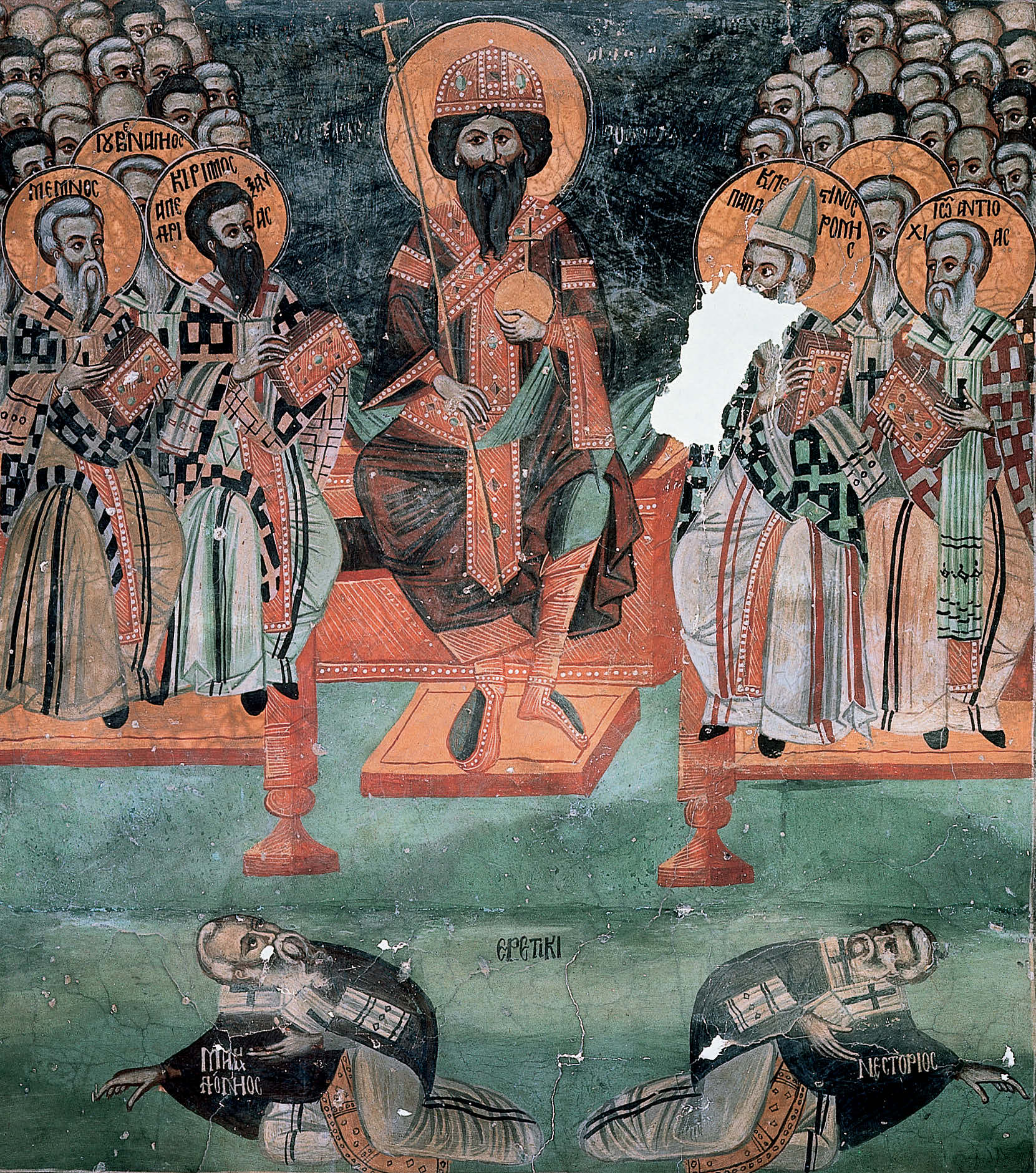
408–450) condemns Patriarch Nestorius (382–451), shown in the lower right, as a heretic. On the emperor’s right sits Patriarch Cyril of Alexandria, to his right Bishop Memnon of Ephesus (far left of picture from viewer’s perspective); on the emperor’s left is Pope Celestine I of Rome, to his left Patriarch John of Antioch (far right of picture from viewer’s perspective). Post-Byzantine mural in the St Sozomenos Church in Galata, Cyprus, from 1513. is born, and use the term Christotokos, Christ- bearer.’62 It is clear from Nestorius’s remarks that he considered both terms, Theotokos and Anthropotokos, equally legitimate, insofar as they were correctly understood. At the same time, however, the patriarch’s chaplain and confidante Anastasius poured oil on the fire by openly attacking the term ‘Theotokos’ in a sermon on 22 November 428. Since Nestorius failed to correct Anastasius’s statement in his advent sermons, the clergy and monks got the impression that Nestorius wanted to impose
408–450)谴责牧首聂斯脱里 (Nestorius, 382–451) 为异端,后者见图中右下方。在皇帝右侧坐着亚历山大的牧首西里尔 (Cyril of Alexandria),在西里尔右侧是以弗所主教梅姆农 (Memnon of Ephesus)(从观看者视角看位于画面最左侧);在皇帝左侧是罗马教宗塞莱斯廷一世 (Celestine I of Rome),在塞莱斯廷左侧是安提阿的牧首约翰 (John of Antioch)(从观看者视角看位于画面最右侧)。塞浦路斯 (Cyprus) 加拉塔 (Galata) 的圣索佐门教堂 (St Sozomenos Church) 中作于1513年的后拜占庭时期壁画。出生了,并使用‘基督之母’(Christotokos),即‘孕育基督者’这一术语。’62 从聂斯脱里的言论可以清楚看出,他认为‘上帝之母’(Theotokos) 和‘人之母’(Anthropotokos) 这两个术语,只要得到正确理解,就同样正当。然而与此同时,牧首的随行司铎兼密友阿纳斯塔修斯 (Anastasius) 却火上浇油,在428年11月22日的一篇讲道中公开攻击‘上帝之母’(Theotokos) 这一术语。由于聂斯脱里在其将临期讲道中没有纠正阿纳斯塔修斯的说法,神职人员和修士们便产生这样的印象:聂斯脱里想要强加
Antiochene ideas on Constantinople. difficult to comprehend intellectually, into the idea, congenial to popular piety, of a familiar trio of gods – God the Father, Mary the Mother, and Jesus as their shared Son – presented a genuine danger in the Mediterranean region, which featured several pagan divine triads.
安提阿学派 (Antiochene) 关于君士坦丁堡 (Constantinople) 的观念,在理智上难以理解,却被带入一种与民间虔敬相契合的观念,即一个熟悉的三神组合——父神、母亲马利亚 (Mary) 以及作为他们共同儿子的耶稣 (Jesus)——这在地中海 (Mediterranean) 地区构成了真正的危险,因为该地区存在若干异教神祇三联体。
Mary enjoyed a widespread and popular cult, which had first arisen in Egypt. It developed there out of the cult of the goddess Isis and her divine son Horus, which had been extremely popular in the Roman period. In many portrayals of the Madonna, the resemblance to images of Isis, with the infant Horus at her breast, is striking. The highly emotional veneration of the Mother of God represents a Christianization of the Isis cult. This particular form of popular piety was also present in the patriarchate of Constantinople, not only in the capital but also in Ephesus, where it was heir to the ancient cult of Artemis and assimilated the figures of ancient mother goddesses into Christianity.63 Thus, when Anastasius appeared to attack the cult of the Mother of God and deny the divinity of Christ, indignation raged, and violent unrest again racked the capital. Startled, Nestorius tried to calm things down with a sermon he gave in early 430: ‘I have already declared several times that when one of you or someone of a simple [nature] prefers the term Theotokos, I will say nothing against this. Just don’t make a goddess out of the Virgin.’64 Nestorius did not oppose the veneration of Mary but rather the worship of her.
马利亚 (Mary) 享有广泛而流行的崇拜,这种崇拜最初兴起于埃及 (Egypt)。它在那里从女神伊西斯 (Isis) 及其神子荷鲁斯 (Horus) 的崇拜发展而来,后者在罗马时期曾极受欢迎。在许多圣母 (Madonna) 形象中,与伊西斯 (Isis) 怀抱婴儿荷鲁斯 (Horus) 的图像之间的相似性令人瞩目。对上帝之母 (Mother of God) 高度情感化的崇敬,代表着伊西斯 (Isis) 崇拜的基督教化。这种特殊形式的民间虔敬也存在于君士坦丁堡牧首区 (patriarchate of Constantinople),不仅在该首府,也在以弗所 (Ephesus);在那里,它继承了古代阿尔忒弥斯 (Artemis) 崇拜,并将古代母神形象吸纳进基督教。63 因此,当阿纳斯塔修斯 (Anastasius) 似乎要攻击上帝之母 (Mother of God) 崇拜并否认基督 (Christ) 的神性时,群情激愤,暴力骚乱再次震撼了首都。聂斯托利 (Nestorius) 大为震惊,试图借他在 430 年初的一次讲道来平息事态:“我已多次声明,当你们中有人或某个天性单纯的人 [simple nature] 更偏爱‘上帝之母’ (Theotokos) 这一说法时,我不会对此表示反对。只是不要把童贞女 (Virgin) 变成一位女神。”64 聂斯托利 (Nestorius) 并不反对对马利亚 (Mary) 的崇敬,而是反对对她的崇拜。
With regard to theology, Nestorius was less willing to compromise. ‘Mary bore a human being, the mediator of divinity, but not God.’ 68 In the end, Nestorius could not accept the term ‘Theotokos’, since it implied a Theopaschite Christology, according to which God was subject to the natural conditions of birth, suffering and death. Beginning with Theodore of Mopsuestia, rejection of the designation ‘Theotokos’ remained a constant of East Syrian theology. The last great theologian of the Church of the East, the metro- politan of Nisibis Mar Odisho (c.1250–1318), argued rather polemically against this concept. First, if Mary is the mother of God, and this term refers to the Trinity, then Mary is the mother of the Trinity. Second, if Mary is the God-bearer, and Christ is the Son of God, then Mary is the mother of God the Father, and Christ is her grandson.69
在神学方面,聂斯脱利 (Nestorius) 不太愿意妥协。“马利亚 (Mary) 生了一个人,即神性的中保,而不是上帝。”68 最终,聂斯脱利无法接受“上帝之母” (Theotokos) 这一术语,因为它暗示了一种上帝受难论的基督论 (Theopaschite Christology),根据这种基督论,上帝受制于出生、受苦和死亡等自然条件。自摩普苏埃斯蒂亚的狄奥多雷 (Theodore of Mopsuestia) 开始,拒绝“上帝之母”这一称号始终是东叙利亚神学 (East Syrian theology) 的一个不变特征。东方教会 (Ch. of E.) 最后一位伟大的神学家、尼西比斯 (Nisibis) 都主教马尔·奥迪绍 (Mar Odisho, 约1250–1318年) 曾相当论战性地反对这一概念。 第一,如果马利亚是上帝之母,而这一术语指称三位一体,那么马利亚就是三位一体的母亲。第二,如果马利亚是上帝承载者 (God-bearer),而基督是上帝之子,那么马利亚就是上帝圣父的母亲,而基督就是她的孙子。69
Nestorius’s attempts at appeasement came too late, for he was isolated and opposed by a hostile alliance made up of Pulcheria, the courtiers, the military leadership, the monks and the rabble of the city. This faction sought the lever with which they could prise their disliked bishop from the patriarchal throne. They found it in Cyril, the patriarch of Alexandria, who, for his part, sought a pretext for bringing down Nestorius. More than a year before the Council of Ephesus in the summer of 431, the fate of Patriarch Nestorius was sealed.
聂斯脱利 (Nestorius) 的安抚尝试来得太迟,因为他已被孤立,并遭到一个敌对联盟的反对;该联盟由普尔喀丽亚 (Pulcheria)、朝臣、军方领袖、修士以及城中的乌合之众组成。这个派系寻找一根杠杆,以便把他们所厌恶的主教从宗主教宝座上撬下来。他们在亚历山大 (Alexandria) 的宗主教西里尔 (Cyril) 身上找到了这根杠杆;而西里尔本人也在寻找一个扳倒聂斯脱利 (Nestorius) 的借口。早在 431 年夏天以弗所公会议 (Council of Ephesus) 召开前一年多,聂斯脱利宗主教 (Patriarch Nestorius) 的命运就已注定。
That Nestorius’s warning not to idolize Mary was not unjustified is demonstrated by the examples of a Christian nomadic tribe from the Syrian desert, which worshipped Mary as a goddess,65 and the apocryphal Gospel of the Hebrews, where the following statement of Jesus is found: ‘The Saviour said, “Immediately my mother, the Holy Spirit, seized me”’.66 From the independent cult of Mary and the equating of her with the Holy Spirit, it was but a short step to tritheism, the belief in three gods. Bishop Maruta (†419) referred to a group of Montanists as an example. ‘These call the blessed Mary a goddess and say that a heavenly being joined with her and the Son of God was borne by her.’67 The devolution of the concept of the Trinity,
聂斯脱利 (Nestorius) 关于不要将马利亚 (Mary) 偶像化的警告并非没有道理,这一点可由以下例子证明:来自叙利亚沙漠 (Syrian desert) 的一个基督教游牧部落将马利亚奉为女神,65 以及伪经《希伯来人福音》(Gospel of the Hebrews) 中记载了耶稣 (Jesus) 的如下话语:“救主 (Saviour) 说:‘立刻,我的母亲,圣灵 (Holy Spirit),抓住了我。’”66 从对马利亚 (Mary) 的独立崇拜以及将她与圣灵 (Holy Spirit) 等同起来,到三神论 (tritheism),即相信有三位神,只有一步之遥。主教马鲁塔 (Bishop Maruta, †419) 曾以一群孟他努派 (Montanists) 为例。“这些人称蒙福的马利亚 (blessed Mary) 为女神,并说一位天上的存在与她结合,而她生下了上帝之子 (Son of God)。”67 三位一体 (Trinity) 概念的退化,
The theological dispute with Patriarch Cyril of Alexandria understood as substance – in three hypostases – understood as persons. We can translate the Greek words usia and physis as ‘nature’, a universal category, a general and immutable type in the sense of a species. So there is the usia of God or the general species of human being. The Syriac word kyana corresponds to the Greek usia. The difficulty began with the term ‘hypostasis’. Cyril and most non-Antiochene theologians interpreted the Greek word in the Neo-Platonic sense as a concrete realization of the usia, corresponding to the concrete person. Nestorius, however, when referring to a concrete person, used the term prosopon, in Syriac parsopa, and inserted the term ‘hypostasis’, Syriac qnoma, in between ‘usia’ and ‘person’. Nestorius and the Church of the East understood the designation ‘hypostasis’ or ‘qnoma’ in the Aristotelian sense, as a material reality bound up with its species. The qnoma is an individual, representative realization of its nature, but does not necessarily exist for itself. The qnoma – that is – the hypostasis, is not yet the person, the prosopon. The prosopon is defined as the sum of accidental qualities that make the appearances of two hypostases different. Such qualities are, for instance, sex, hair colour, character traits, degree of intelligence, talents, etc. These qualities distinguish Peter from Paul or John from James. Applied to the example of the human being, usia/kyana refers to the general species of human, hypostasis/qnoma to a real, existing realization, and prosopon/parsopa to the appearance of the actual person.70 In brief, ‘person’ denotes the external appearance and ‘hypostasis’ the inner reality.
与亚历山大牧首济利禄(Cyril of Alexandria)的神学争论中,‘本质’被理解为实体——‘三个位格’则被理解为人格。希腊词 ousia 和 physis 可以译作‘本性’,即一种普遍范畴、一般且不变的类型,意义上相当于一个物种。因此,存在上帝的 ousia,也存在人这一一般物种。叙利亚语 kyana 对应希腊语 ousia。困难始于‘位格’一词。济利禄以及大多数非安提阿神学家按照新柏拉图主义的意义解释希腊词,认为位格是 ousia 的具体实现,对应于具体的人格。然而,涅斯托留(Nestorius)指称具体人格时使用 prosopon 一词,叙利亚语作 parsopa,并在‘本质’与‘人格’之间插入‘位格’一词,叙利亚语作 qnoma。涅斯托留和东方教会(Church of the East)按照亚里士多德主义的意义理解‘位格’或 qnoma 这一称谓,把它视为与所属物种相连的物质实在。qnoma 是其本性的个别、具代表性的实现,但不一定独立存在。qnoma——也就是位格——尚不是人格,即 prosopon。prosopon 的定义,是使两个位格的外在显现有所不同的一切偶性特征的总和。例如,这些特征包括性别、发色、性格特征、智力程度、才能等。正是这些特征使彼得有别于保罗,或使约翰有别于雅各。以人为例,ousia/kyana 指人这一一般物种,hypostasis/qnoma 指现实存在的具体实现,而 prosopon/parsopa 指实际人格的外在显现。70 简言之,‘人格’指外在显现,‘位格’指内在实在。
In 412 Cyril (c.375–444) succeeded his uncle Theophilus as patriarch of Alexandria. His character was in direct contrast to Nestorius’s. Cyril was ambitious and power-hungry, politically savvy and a master schemer, who did not hesitate knowingly to misquote his opponent Nestorius to the pope. Cyril’s motivations for using the alliance hostile to Nestorius as an instrument to effect his fall were threefold. First, in 381 the patriarchate of Alexandria was demoted from its position as the second most important patriarchate after Rome to the third, in favour of Constantinople, which aroused great resentment in Alexandria. Second, Cyril strived either to become patriarch of Constantinople or to re-establish Alexandria’s former place in the hierarchy. Third, Nestorius’s rejection of the term ‘Theotokos’ represented a provocation for Alexandrians and Egyptians.
412年,西里尔(Cyril,约375–444年)接替其叔父提阿非罗(Theophilus)成为亚历山大里亚(Alexandria)宗主教。他的性格与聂斯脱利(Nestorius)截然相反。西里尔野心勃勃、贪恋权势,政治上精明,且是权谋大师,会毫不迟疑地故意向教皇曲引其对手聂斯脱利的话。西里尔利用敌视聂斯脱利的联盟作为促成其倒台的工具,其动机有三方面。第一,381年,亚历山大里亚宗主教区从仅次于罗马(Rome)的第二重要宗主教区被降为第三,让位于君士坦丁堡(Constantinople),这在亚历山大里亚引起了极大不满。第二,西里尔力图要么成为君士坦丁堡宗主教,要么恢复亚历山大里亚在教阶体系中的原有地位。第三,聂斯脱利拒绝“上帝之母”(Theotokos)一词,对亚历山大里亚人和埃及人而言是一种挑衅。
Cyril chose the argument that Nestorius’s rejection of the designation of the Mother of God showed that he – like Paul of Samosata, who had been condemned as a heretic in 268 – maintained that Jesus was merely a man, whom God later adopted on account of his moral development. On the occasion of the Easter sermon of 429 he publicly charged Nestorius with denying the divinity of Christ. At the same time, an increasingly aggressive correspondence began between the two patriarchs, culminating in twelve extraordinarily sharply formulated anathemas by Cyril against Nestorius. Before we briefly sketch out the relevant arguments, three important philosophical terms – ‘nature’, ‘hypostasis’, and ‘person’ – need to be clarified. Doing so will show that the two adversaries sometimes interpreted the same terms differently.
西里尔 (Cyril) 选择了这样一种论证:聂斯脱利 (Nestorius) 拒绝“上帝之母” (Theotokos) 这一称号,表明他——就像268年被判为异端的萨莫萨塔的保罗 (Paul of Samosata) 一样——坚持认为耶稣仅仅是一个人,上帝后来因他的道德发展而将他收为嗣子。在429年复活节讲道之际,他公开指控聂斯脱利否认基督的神性。与此同时,两位宗主教之间开始了日益激烈的书信往来,最终导致西里尔针对聂斯脱利提出十二道措辞极其尖锐的绝罚。在我们简要勾勒相关论证之前,有三个重要的哲学术语——“本性”(nature)、“位格”(hypostasis)和“人格”(person)——需要加以澄清。这样做将表明,这两位对手有时对相同的术语作出了不同的解释。
Both Cyril and Nestorius spoke of a divine and a human nature in Christ, but they differed from one another in the determination of the modality of unity. In his second letter to Nestorius, Cyril wrote, ‘Two different natures came together [in Christ] in a hypostatic union, in order to form a unity.’71 But, because Nestorius defined the term
西里尔 (Cyril) 和聂斯脱利 (Nestorius) 都谈到基督 (Christ) 里的一种神性和一种人性,但他们在对合一方式的界定上彼此不同。在其致聂斯脱利的第二封信中,西里尔写道:“两种不同的本性在[基督里]于位格联合 (hypostatic union) 中结合在一起,以形成一个统一体。”71 但是,因为聂斯脱利界定了该术语
The fundamental basis is the definition of the Trinity from 381, which speaks of one usia –
根本基础是381年关于三位一体的定义,其中谈到一个本质 (usia) –
‘hypostasis’ as a pre-personal reality, the concept of a hypostatic union was unacceptable to him, since he saw this as a mixing of the two natures. Such a mixing endangered the integrity of the human nature and led to the idea that the divine in Christ was subject to such earthly phenomena as birth, suffering and death.72 For Nestorius it was unthinkable that a usia (nature) could exist in a prosopon without a corresponding hypostasis. He countered Cyril’s hypostatic union with the union in the prosopon: ‘In Christ two natures and two hypostases are united in the prosopon.’ He expanded this formula, which was adopted by the Church of the East, as follows: ‘I confess in One Christ two natures without mixing. In his divinity he was brought forth by the Father, in his humanity by the Holy Virgin.’73
“若将‘位格’(hypostasis)视为一种前位格性的实在,那么位格联合(hypostatic union)的概念对他而言便不可接受,因为他将此看作两种本性的混合。这种混合危及人性的完整性,并导致这样一种观念:基督内的神性受制于诸如出生、受苦和死亡这类尘世现象。72 对聂斯托利(Nestorius)而言,一个本体(usia,即本性)能够存在于一个位格(prosopon)之中,却没有一个与之相应的位格(hypostasis),这是不可想象的。他以‘在位格(prosopon)中的联合’来反驳西里尔(Cyril)的位格联合(hypostatic union):‘在基督里,两种本性与两个位格(hypostases)在一位格(prosopon)中联合。’他将这一被东方教会(Ch. of E.)所采纳的公式进一步阐述如下:‘我在一位基督里承认两种本性,不相混合。按其神性,他由父所生;按其人性,他由圣童贞女所生。’73
Patriarch Cyril of Alexandria (375–444). Mural in the Syrian Orthodox monastery of Mar Musa, Syria, twelfth century.
亚历山大的牧首西里尔 (Patriarch Cyril of Alexandria)(375–444)。叙利亚正教会 (Syrian Orthodox) 的圣摩西修道院 (Mar Musa) 中的壁画,叙利亚,十二世纪。
In the formulation of Babai the Great (551–628), still recognized today, the creed of the Church of the East reads: ‘One is Christ, the Son of God, glorified by all in two natures; begotten by the Father without beginning before time; born of Mary in his humanity, united in the fullness of time in one body. His divinity is not of the nature of the mother, nor is his humanity of the nature of the Father. The natures are preserved in their qnome [hypostases] in one person of the one sonship.’74
在大巴拜 (Babai the Great)(551–628)的表述中——这一表述至今仍获认可——东方教会 (Ch. of E.) 的信经写道:“基督是独一的,是上帝的儿子,在二性中受所有人荣耀;在时间之前、无始地由父所生;按其人性由马利亚 (Mary) 所生,在时间圆满之际联合于一个身体。他的神性并非出自母亲的本性,他的人性也并非出自父的本性。二性保存在其位格 (qnome [hypostases]) 中,在独一儿子身份的一个位格中。”74
Nestorius did not give up, Cyril resorted to a ruse and turned to Pope Celestine I (†432). In his writings he did not hesitate to distort citations from Nestorius’s sermons and writings, in order to make them appear as heretical as possible.78 These libels found in the pope a sympathetic audience; for he was angry that Nestorius had welcomed the condemned adherents of Pelagius in Constantinople.79 In August 430 Celestine convened a synod in Rome, which condemned Nestorius as a heretical follower of Paul of Samosata and conclusively prescribed use of the term ‘Theotokos’. Nestorius had to correct his errors or face deposition.
聂斯托利 (Nestorius) 并未罢休,西里尔 (Cyril) 则施以诡计,求助于教宗策肋定一世 (Celestine I)(†432)。在其著作中,他毫不犹豫地歪曲聂斯托利讲道和著作中的引文,以使它们尽可能显得具有异端色彩。78 这些诬蔑之词在教宗那里得到了同情的倾听;因为他对于聂斯托利在君士坦丁堡 (Constantinople) 接纳了已被定罪的伯拉纠 (Pelagius) 追随者一事感到愤怒。79 430年8月,策肋定在罗马 (Rome) 召开了一次主教会议,该会议谴责聂斯托利为萨莫萨塔的保罗 (Paul of Samosata) 的异端追随者,并最终规定使用“上帝之母”(Theotokos) 这一术语。聂斯托利必须纠正其错误,否则将面临被罢免。
Cyril opposed the formulation of Nestorius: ‘He who rejects the hypostatic union commits the error of two Sons.’75 Since Cyril equated the term ‘hypostasis’ with the term ‘person’, the phrase ‘in two hypostases’ in Nestorius’s formulation must have meant, to his mind, ‘in two persons’, which is heretical. Although the noose slowly tightened around Nestorius, he refused to heed the advice of his mentor, Patriarch John of Antioch, and accept the term ‘Theotokos’.76 By doing so, he could have pulled the rug out from under Cyril’s reasoning. Instead, in his second letter to Cyril, he reiterated that ‘the Holy Virgin is more properly called Christotokos than Theotokos’.77 Since
西里尔 (Cyril) 反对聂斯脱利 (Nestorius) 的表述:“凡拒绝位格联合 (hypostatic union) 者,便犯了两个儿子的错误。”75 由于西里尔 (Cyril) 将“位格”(hypostasis) 一词与“位格”(person) 一词等同起来,聂斯脱利 (Nestorius) 表述中的“在两个位格中”(in two hypostases) 一语,在他看来必定意味着“在两个位格中”(in two persons),而这是异端。尽管绞索正慢慢在聂斯脱利 (Nestorius) 周围收紧,他却拒绝听从其导师安提阿宗主教约翰 (John of Antioch) 的劝告,不肯接受“上帝之母”(Theotokos) 一词。76 若他这样做,本可抽掉西里尔 (Cyril) 论证的根基。相反,在写给西里尔 (Cyril) 的第二封信中,他重申:“神圣童贞女更恰当地被称为‘基督之母’(Christotokos),而非‘上帝之母’(Theotokos)。”77 由于
The synod authorized Cyril to settle the matter. He seized the opportunity and confronted Nestorius with twelve anathemas, which he had ten days to sign or else he would be condemned. These anathemas were so pointedly formulated
会议授权西里尔 (Cyril) 处理此事。他抓住机会,以十二项绝罚与聂斯脱利 (Nestorius) 对质,限他十天内签署,否则他将被定罪。这些绝罚条款的措辞如此尖锐,
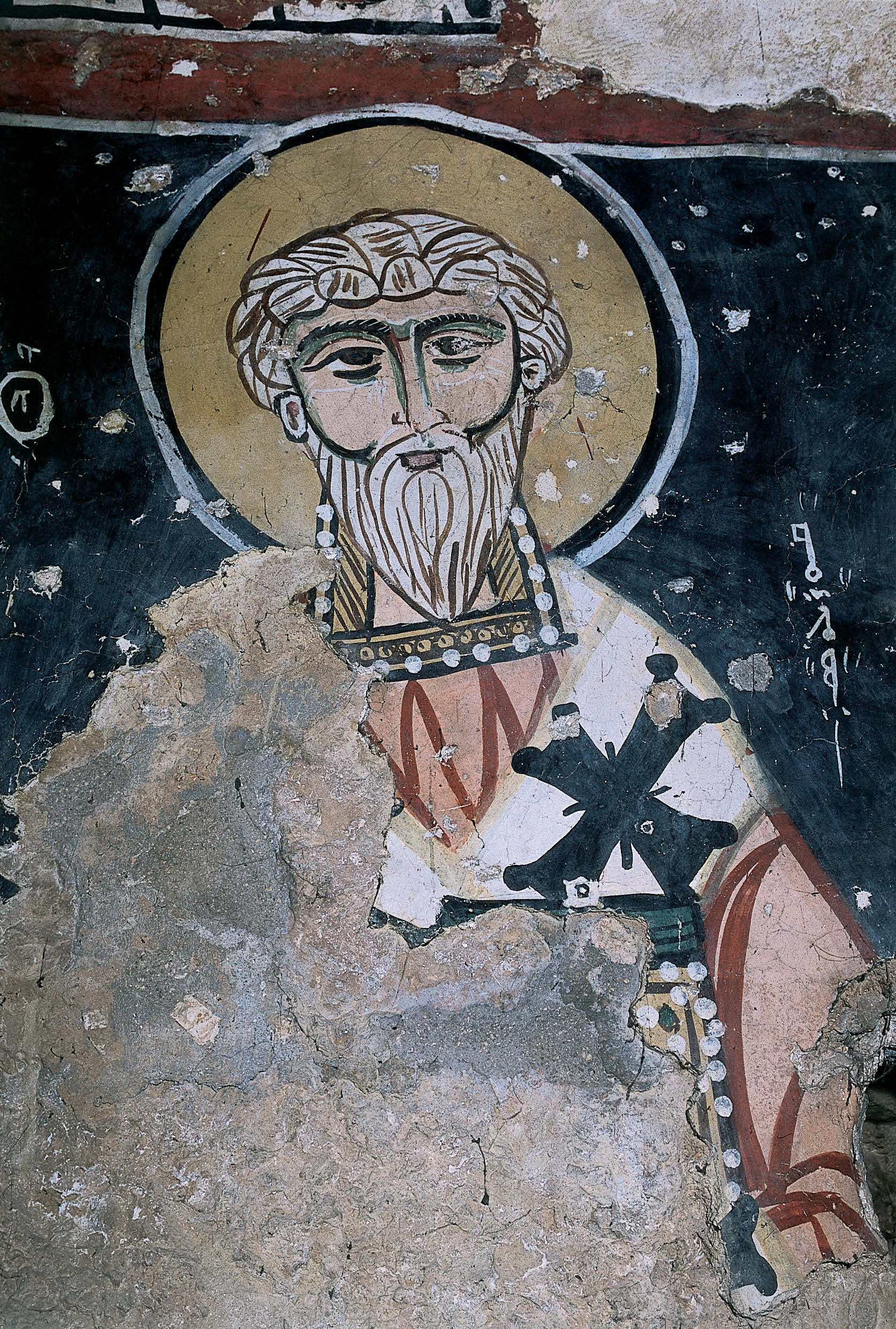
that Nestorius could not submit to them without losing his credibility. This is clear from the first two and the final threatened condemnations: these circumstances, Nestorius, who was present in Ephesus, refused to participate in this biased council. The correspondence between the two opponents was read aloud, and within days, and without discussion, Nestorius was condemned in absentia as a heretic and relieved of his office.81 The decision was made known to Nestorius in writing. ‘The holy council, meeting in Ephesus by the grace of God and at the behest of our pious and Christ- loving emperor, informs Nestorius, the new Judas: know that, on account of your impious doctrines and disobedience to the canons, you have been condemned by the holy synod after the findings of the ecclesiastical determinations on 22 June of the current month of June, and you have forfeited all ecclesiastical titles.’82
聂斯脱利 (Nestorius) 若服从它们,就不可能不丧失自己的威信。这一点从最初两次以及最后威胁要作出的谴责中可以清楚看出:在这些情况下,当时身在以弗所 (Ephesus) 的聂斯脱利拒绝参加这个有偏见的会议。两位对手之间的往来书信被当众宣读,数日之内,且未经讨论,聂斯脱利便因缺席而被定为异端,并被解除职务。81 这一决定以书面形式通知了聂斯脱利。“蒙上帝恩典并应我们虔诚且热爱基督的皇帝之命,在以弗所召开的神圣会议,特此通知新犹大聂斯脱利:须知,因你不敬虔的教义和不服从教规,在本月6月22日教会裁决结果公布之后,你已被神圣主教会议定罪,并已丧失一切教会头衔。”82
One who does not confess Immanuel as the true God and thus the Holy Virgin as God- bearer, because she bore in the flesh the God Logos born of the flesh, is condemned. 2. One who does not confess that the Logos, begotten of God the Father, is hypostatically united with the flesh is condemned. 12. One who does not confess that the Logos
凡不承认以马内利 (Immanuel) 为真神,因而也不承认圣童贞女为生神者 (God-bearer) 的——因为她曾在肉身中孕育了那由肉身而生的上帝圣言 (God Logos)——就被定罪。 2. 凡不承认那由父上帝所生的圣言 (Logos) 已按位格与肉身联合的,就被定罪。 12. 凡不承认圣言 (Logos)
God suffered in the flesh and was crucified in the flesh and tasted death in the flesh is condemned.80
“上帝在肉身中受苦,在肉身中被钉十字架,在肉身中尝了死味”是被定罪的。80
Nestorius rejected the anathemas as the monstrous product of the condemned doctrine of Apollinarius and demanded that the emperor call a general council, which he did, inviting all the bishops on 7 June 431 to Ephesus. The selection of Ephesus as the location of the council, presumably suggested by Pulcheria, was a bad omen for Nestorius. The city lived from the veneration of the Mother of God, which was heir to the pagan cult of Artemis. For this reason, the local bishop Memnon was an ardent supporter of the term ‘Theotokos’ and a bitter opponent of his patriarch.
聂斯托利 (Nestorius) 拒绝接受那些绝罚文,认为它们是被定罪的阿波利拿里 (Apollinarius) 教义所产生的骇人产物,并要求皇帝召开一次大公会议。皇帝照办了,于431年6月7日邀请所有主教前往以弗所 (Ephesus)。选择以弗所 (Ephesus) 作为会议地点——据推测是由普尔喀丽亚 (Pulcheria) 提议的——对聂斯托利 (Nestorius) 而言是个不祥之兆。这座城市赖以为生的是对上帝之母 (Theotokos) 的敬拜,而这种敬拜继承了异教的阿尔忒弥斯 (Artemis) 崇拜。因此,当地主教梅姆农 (Memnon) 是“上帝之母” (Theotokos) 这一术语的热烈支持者,也是其宗主教的激烈反对者。
When the bishops of Antioch, under the leadership of their patriarch, John, arrived in Ephesus on 26 June, they held an opposing council and, as a countermove, deposed Cyril and Memnon. This led to a stalemate, which only the emperor could resolve. First he placed all three adversaries under house arrest. But recalling the earlier popular tumult directed against the patriarch and renewed pressure on the part of the monks, he let Nestorius fall and sent him back to his monastery. By means of bribery, Cyril and Memnon succeeded in regaining their offices. While Nestorius was, on a personal level, the loser in this dispute, with regard to dogma Cyril had to submit two years later and sign a formula of reconciliation that stood closer to Nestorius’s ideas than to his own. The Church itself emerged as the true loser, as over the course of the next 20 years its unity shattered into three mutually antagonistic Churches. Looked at in the short term, the removal of Nestorius from office signified a victory for the patriarchates of Rome and Alexandria over those of Constantinople and Antioch.
当安条克 (Antioch) 的主教们在其宗主教约翰 (John) 的领导下于6月26日抵达以弗所 (Ephesus) 时,他们召开了一个对立会议,并作为反制措施罢免了西里尔 (Cyril) 和梅姆农 (Memnon)。这导致了僵局,唯有皇帝才能化解。他首先将三位对手全部软禁。但鉴于此前针对这位宗主教(即聂斯脱利)的民众骚乱,以及修士方面重新施加的压力,他舍弃了聂斯脱利 (Nestorius),将他遣送回其修道院。通过贿赂,西里尔 (Cyril) 和梅姆农 (Memnon) 成功恢复了职位。尽管聂斯脱利在个人层面是这场争端中的输家,但在教义方面,西里尔两年后不得不屈服,并签署了一份和解信式,该信式更接近聂斯脱利的思想,而非他自己的思想。教会本身则成为真正的输家,因为在接下来的20年里,其统一性破裂为三个相互敌对的教会。从短期来看,罢免聂斯脱利的职务意味着罗马 (Rome) 和亚历山大里亚 (Alexandria) 的宗主教区对君士坦丁堡 (Constantinople) 和安条克 (Antioch) 宗主教区的胜利。
Nestorius’s removal as patriarch
聂斯脱利 (Nestorius) 被免去牧首职务
The Third Ecumenical Council of Ephesus was an undignified event. Egyptian monks and sailors ran wild in the streets and threatened supporters of the patriarch. An additional and, indeed, decisive misfortune for Nestorius was the late arrival of the bishops of the patriarchate of Antioch, as well as the imperial and papal delegations. Against the protest of 68 bishops, Cyril opened the council on 22 June with ‘his’ – in some cases demonstrably bribed – bishops. Since he was leader of the council, Cyril functioned simultaneously as prosecutor and judge. In light of
以弗所第三次大公会议 (Third Ecumenical Council of Ephesus) 是一桩有失体面的事件。埃及僧侣和水手在街头肆意横行,并威胁宗主教的支持者。对聂斯托利 (Nestorius) 而言,另一桩、实际上也是决定性的不幸,是安提阿宗主教区 (patriarchate of Antioch) 的主教们以及帝国使团和教宗使团迟迟才到。不顾68位主教的抗议,西里尔 (Cyril) 于6月22日带着“他的”——在某些情况下可证明是受贿赂的——主教们,宣布会议开幕。由于他是会议的主持者,西里尔 (Cyril) 同时充当了控方和法官。鉴于
Ephesus placed in the stocks of heresy not only Nestorius but also the Antiochene school of
以弗所 (Ephesus) 不仅将聂斯脱利 (Nestorius),而且将安提阿学派 (Antiochene school) 的……都置于异端的枷锁之中
thought. More than a dozen Antiochene bishops were deposed, and adherents of the school were persecuted on behalf of the state, triggering a wave of immigration into neighbouring Persia, which culminated in the closing of the School of the Persians in Edessa. It was this development, combined with the efforts of the Church of the East to distance itself, for political reasons, as much as possible from Byzantium, that motivated the Church of the East to appropriate Theodore of Mopsuestia as their key teacher. the manuscript was the Bazaar of Heracleides, the principal work of Nestorius. In it he refuted point by point all the accusations made against him. When he completed it in 451, a few weeks before his death, he sensed his imminent end and closed with the following tranquil words: ‘The moment of my death now draws near, and every day I beg God to release me, whose eyes have seen God’s grace. Rejoice, you desert, my friend, provider, and home, and you, exile, my mother, which will keep my body after my death until resurrection, God willing. Amen.’87
思想。十多位安提阿的 (Antiochene) 主教被废黜,该学派的追随者则在国家授意下受到迫害,引发了一波迁入邻邦波斯 (Persia) 的移民潮,最终导致埃德萨 (Edessa) 的波斯人学校 (School of the Persians) 被关闭。正是这一发展,加之东方教会 (Ch. of E.) 出于政治原因尽可能与拜占庭 (Byzantium) 保持距离的努力,促使东方教会 (Ch. of E.) 将摩普苏埃斯蒂亚的狄奥多雷 (Theodore of Mopsuestia) 尊奉为其核心导师。这份手稿就是《赫拉克利德斯的集市》(Bazaar of Heracleides),即聂斯托利 (Nestorius) 的主要著作。他在书中逐点驳斥了所有针对他的指控。当他在451年完成此书时,距其去世仅数周,他感到自己大限将至,并以如下平静的话语作结:“我死亡的时刻现已临近,我每日祈求上帝释放我,因我的双眼已得见上帝的恩典。欢欣吧,你这旷野,我的朋友、供养者和家园;也欢欣吧,你这流放地,我的母亲,你将在死后保存我的身体,直到复活,若上帝愿意。阿门。”87
Nestorius spent four years in his monastery, until, at the instigation of his one-time mentor John of Antioch, he was sent into exile in Egypt. At the same time, Emperor Theodosius ordered the burning of the collected writings of his former patriarch – a harbinger of the Inquisition. In order to expunge every memory of Nestorius, children who bore his name were rebaptized with new names.83 In exile Nestorius remained a keen observer of developments in the Church and produced numerous writings, although he harboured no illusions about a possible rehabilitation. ‘I have lost interest in human matters. I have left the world and live for Him who gave me life.’84 Although his friends pressured him repeatedly to turn to the pope and clarify his theological views in writing, he refused, for he was aware of ‘the prejudices against [his] person’.85
聂斯托利 (Nestorius) 在其修道院度过了四年,直到在其昔日导师安提阿的约翰 (John of Antioch) 的怂恿下,被流放到埃及 (Egypt)。与此同时,狄奥多西皇帝 (Emperor Theodosius) 下令焚毁其前任牧首的文集——这是宗教裁判所 (Inquisition) 的先兆。为了抹去关于聂斯托利 (Nestorius) 的一切记忆,那些以他的名字命名的孩子被重新施洗,并改换新名。83在流放期间,聂斯托利 (Nestorius) 仍密切关注教会的发展,并撰写了大量著作,尽管他对可能恢复地位不抱任何幻想。“我已对人间事务失去兴趣。我已离开世界,为那位赐我生命者而活。”84尽管他的朋友们一再催促他求助于教宗 (pope),并以书面形式澄清自己的神学观点,他却拒绝了,因为他意识到“针对[他]本人的偏见”。85
Did Nestorius indeed teach the heresy that bears his name? If we understand ‘Nestorianism’ as that heresy that sees in Christ two persons, which are connected to one another only in a loose moral bond (i.e. that teaches two Sons and denies the complete incarnation), then the Bazaar of Heracleides corrects this misconception. Nestorius was no Nestorian in the canonical sense; he never taught the heresy attributed to him. In his writings in his defence, he vehemently denied the accusation that he was an Adoptionist – that is, that he taught that God the Father adopted the purely human Jesus on account of his perfect morality. He emphasized again and again the complete ontological unity of Christ and the genuine incarnation of the Word in him, which did not happen only at his baptism but, rather, simultaneously with the Annunciation to Mary. He countered the charge that he implied two Sons with his concept of the union in the prosopon.88
聂斯托利 (Nestorius) 真的教导了以他名字命名的异端吗?如果我们把“聂斯托利主义” (Nestorianism) 理解为这样一种异端:它在基督 (Christ) 内看到两个位格,二者仅以松散的道德纽带彼此相连(即教导两个儿子并否认完整的道成肉身),那么《赫拉克利德斯的集市》(Bazaar of Heracleides) 就纠正了这一误解。按正统定义,聂斯托利 (Nestorius) 并不是聂斯托利主义者 (Nestorian);他从未教导过被归咎于他的异端。在其辩护性著作中,他激烈否认关于他是嗣子论者 (Adoptionist) 的指控——也就是说,他否认自己曾教导说,圣父 (God the Father) 因纯然人性的耶稣 (Jesus) 拥有完美的道德而收养了他。他一再强调基督 (Christ) 在本体论上的完全统一,以及圣言 (Word) 在他里面的真实道成肉身;这并非仅发生在他受洗之时,而是与向马利亚 (Mary) 报喜 (Annunciation) 同时发生。他以位格 (prosopon) 中的联合这一概念,反驳了他暗示两个儿子的指控。88
Since his writings were burned, Nestorius is known outside the Church of the East only through the accusations and slander of Cyril, and thus the belief that he was correctly condemned as a heretic prevailed. In Kotchannes, the Nestorian patriarchal see in Kurdistan,86 a Syriac manuscript from c.1100 was preserved. When, in the 1880s, American missionaries heard the rumour that this manuscript was the translation of Nestorius’s chief work, originally written in Greek, a Syrian priest succeeded in secretly making a copy of it in 1889. The discovery was a sensation because
由于他的著作被焚毁,聂斯脱利 (Nestorius) 在东方教会 (Ch. of E.) 之外,仅通过西里尔 (Cyril) 的指控与诽谤才为人所知,因此,他被正确地判为异端这一看法便盛行起来。在库尔德斯坦 (Kurdistan)86 的聂斯脱利派宗主教座科查内斯 (Kotchannes),一份约1100年的叙利亚文抄本得以保存。19世纪80年代,当美国传教士听闻一则传闻,说这份抄本是聂斯脱利 (Nestorius) 主要著作的译本,而该著作原以希腊文写成时,一位叙利亚教士于1889年成功秘密地抄录了一份。这一发现引起了轰动,因为
To understand Nestorius’s position, it is also enlightening to consider his agreement with the formula of Pope Leo I, which laid the foundation of the Chalcedonian creed in 451.89 In the Bazaar of Heracleides he declared repeatedly that ‘this creed [of the bishop of Rome] was orthodox and unobjectionable’.90 According to Jacobite authors – i.e. theological opponents of Nestorius – the deposed patriarch died one day before the arrival of the message inviting him to participate in the
要理解聂斯托利 (Nestorius) 的立场,考察他与教皇利奥一世 (Pope Leo I) 的信仰表述的一致之处,也很有启发;该表述为451年的迦克墩信经 (Chalcedonian creed) 奠定了基础。89 在《赫拉克利德斯的集市》 (The Bazaar of Heracleides) 中,他反复宣称:“这一信条[罗马主教的信条]是正统的,无可指摘的”。90 根据雅各派作者 (Jacobite authors)——即聂斯托利的神学对手——的说法,这位被废黜的牧首在邀请他参加……的消息到达的前一天去世。
The Christian necropolis of El Bagawat in the Egyptian oasis of Kharga, where Patriarch Nestorius lived in exile from 435 until his death in 451.
位于埃及哈尔加 (Kharga) 绿洲的埃尔巴加瓦特 (El Bagawat) 基督教墓地,牧首聂斯托利 (Nestorius) 自435年起在此流亡,直至451年去世。
Council of Chalcedon.91 Even if Nestorius had attended this council and accepted its creed, it is unlikely that the council would have rehabilitated him, since he was hated by far too many bishops. Such a rehabilitation would have also called into doubt the Council of Ephesus.92 as his formula of a ‘natural union’ of the two dimensions of Christ93 was replaced by a two- nature formula. ‘We confess that our Lord Jesus Christ…is wholly God and wholly man. [He is] one in substance with the Father in his divinity and one in substance with us in his humanity. It was a union of two natures.’94 In retaliation, Cyril demanded and received confirmation of Nestorius’s condemnation. It was especially tragic for Nestorius that he was sacrificed on the altar of the formula of union, since he could have agreed to its content. Several bishops of Antioch, who did not want to subscribe to the denunciation of their intellectual forefather, fled to Iran, where they joined the Church of the East.
迦克墩公会议 (Council of Chalcedon)。91 即使聂斯托利 (Nestorius) 出席了这次会议并接受了其信经,会议也不太可能恢复他的名誉,因为他被太多主教憎恨。这样的恢复也会使以弗所公会议 (Council of Ephesus) 受到质疑。92 因为他的基督两个维度“自然联合”的公式93 被两性公式取代。“我们承认我们的主耶稣基督……完全是神,完全是人。[他] 在神性上与父同质,在人性上与我们同质。这是两个本性的联合。”94 作为报复,西里尔 (Cyril) 要求并获得了对聂斯托利 (Nestorius) 定罪的确认。对聂斯托利来说尤其悲惨的是,他被牺牲在联合公式的祭坛上,因为他本可以同意其内容。安提阿 (Antioch) 的几位主教不愿赞同对其思想先驱的谴责,逃往伊朗 (Iran),在那里加入了东方教会 (Ch. of E.)。
Although Cyril had pushed through his extreme formulations at the Council of Ephesus, the continuing opposition of the bishops of Antioch forced the emperor to seek a compromise. In 433 John of Antioch and Cyril of Alexandria signed the formula of union produced by Theodoret of Kyros (†c.466), a moderate adherent of the School of Antioch. With regard to theology Cyril had to submit,
尽管西里尔 (Cyril) 在以弗所公会议 (Council of Ephesus) 上强行通过了他那些极端的表述,安提阿 (Antioch) 主教们的持续反对仍迫使皇帝寻求妥协。433年,安提阿的约翰 (John of Antioch) 与亚历山大的西里尔 (Cyril of Alexandria) 签署了由基罗斯的狄奥多勒 (Theodoret of Kyros)(†约466年)拟定的《联合信条》(formula of union);狄奥多勒是安提阿学派 (School of Antioch) 的一位温和追随者。在神学方面,西里尔不得不让步,